A Meta Gaming Blog talking about How to Frame Narrative, Exploiting and Exploring Biases, and Using Work Productivity and Motivation tools in a TRPGs most of the time.
what is the objective measure of pushing a story forward in an enjoyable way?
Pulling back the veil I realize in storytelling I realize the traditional scene is the GM set up and the Players decision. The scene stalls when the players decide on a path that leads to no escalation, the story or plot doesnt move, or when the whole scene is scrapped.
Mechanics like in 2D20, Fate, and other Storytelling mediums Push the scene to the Players and the GM becomes an editor - correcting the scene if it lacks Risks/Threats, Tension, Stakes, Clear Conflict, Engagement for the other Players etc...
GM "Yeah ok, so your going to go to the Kings Court/ Dragon/ High Priest with this? Ok what are the stakes and risk?"
Ideally the players DONT WANT the rewards handed to them. That there is a cost to what their PCs want and its in this Trade Off where character development happens.
One of the weird things where the people who Play TRPGs need to align are "Your PCs motives are that they want X - but they have other Conflicting fellow PCs and they cant just get what they want for nothing right? What development and trial will the PC's go through? What will make the Player want to experience some set backs for catharsis?
The Dice is to determine if Unlikely or Likely events happen. That what would be unusual or usual happen to the character. It is to organically create the setbacks that build up the story.
In fact if the challenge is very overpowered to the PCs, we wont beleive the PCs are over their head unless the dice statistics show that and their strategy show that. That our own ability to judge the story for engaging is being able to accept the likeliness of the events.
What objectively moves the story forward - is the mutual agreement of the Parties invovled that there was Tension and Catharsis. That we have Tools in the game system that allows us to take on my Tension (Risk and Obstacles) for Catharsis.
In storytelling - Failures are the backdrop of what would be a High Stakes scene!
That the Players agree in a criteria where they will have something to modify the Odds as they take on setbacks. So that the setbacks are not indefinite.
It was my wife and women in my life who had to explain to me the importance of just being Present and being able to listen. While most of my mentors are men in problem-solving and critical thinking, the women in my life had to teach me the value of emotional labor and intelligence.
In a TRPG we don't have situations of emotional labor, but in real life - Holy crap the amount of emotional labor we have to face outweighs the Problem Solving. Problem Solving can be Googled or you can Youtube it or Crowdsource it - Emotional Labor is like Muscle and Bone density and disposition - you either have it or don't.
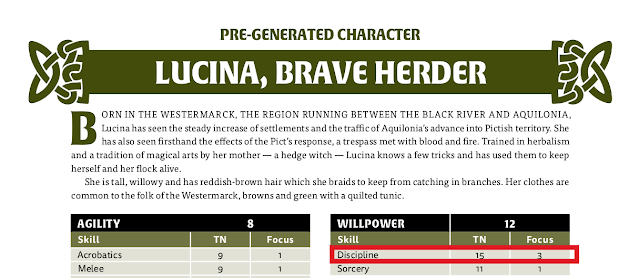
So when I saw Lucina the Brave Herder - I realize she is Sub Optimal in Conan. In a Conan story she would be a damsel in distress - an empowered damsel "unFrazetta Sexy" damsel - but in need of Brawn.
Emotional Labor in Games are scenes where someone has to Listen and Take on large amount of Stress. Like Listening to End Users and their problems, BUT resisting the urge to solve it for them and instead get it out in the open and make the person feel like they can communicate their problems without their worth being diminished.
Understanding how we as a society are dysfunctional in the ability to talk about problems is essential in understanding how to frame how Important and life-changing - and dramatic and epic Emotional Labor can be.
Agency - what we crave in the game - the feeling that despite the odds we matter - is a seed that springs from feeling we matter and someone who makes us feel we matter. When people make bad decisions and in the AGGREGATE all these problematic behaviors create a dysfunctional and scary society - Resolve, Empathy, and Understanding are powerful forces that drive a character to act in a heroic context.
Too often in Stories focus on the ACTION. while ignoring the CAUSE OF ACTION or CALL TO ACTION. Information/Knowledge - that we matter, that there is someone to protect or care for makes a character into a hero of a story that is interesting and engaging.
Emotional Labor = the work done by social workers, councilors, suicide hotline volunteers, mediators, therapists, friends and loved ones - is TIME these people will not get back given to another person to repair and recover their agency and their ability to make sense and master their future.
Imagine if we were taxed by our Time and not money, how "equal" things will be, and how much empathy can we have for people in systemic problems and ills of society. If one cannot value time - it's hard to see our effect on the time of others and those around us. My gamer mindset is always trying to see things in a different set of mechanics and systems. I realize some narratives are not appropriate for some games - i don't think it would be appropriate for this kind of meta agency analysis in a Conan game. Its more for CoC or Kult. So I realize the character is sub-optimal for the sample adventures given, especially when Violence is the agreed-upon catharsis of the group.
This is a part of an ongoing reflection of running games when you have very little time left because of real life.
Games are primarily a conversation, particularly the player narrating something that engages them strongly. Placing their character in a situation they are strongly conflicted about: it is not just something they like but something where their character has stakes and but their character's personality (人物性格)and history/background (来历).
This means that in a 2 hour session, the GM has to set up something that will get the Player to engage and narrate.
If you've tried to control meetings and realize topics tend to be uncontrollable in scope. Meetings with substance that cannot fit in an email are 1.5-2 hours long. We talk about concepts as dense as world-building and character history and motivation in most Biz Analysis meetings.
So how do we prepare for such games? Again the principle of a PLAN tells us if we are need to change what we are doing means we write down the inputs, actions/processes, and outcomes we intend. So we write down our plan for each player and ideally arrange that in a MAP or Diagram.
On the diagram we map the 3 phases of the adventure (expectations/set up, the conflict/violation of expectation, and the outcomes that pay-off the players).
A box/process (in chinese process can be translated as 经验,经过,to go through is easily confused with the concept of experience) we name this our PCs/Players and place them working backwards from their outcome to conflict and what input or expectations will trigger a particular experience in the player.
Keeping it Simple.
Just write the Hook or the Outcomes for the Players and their Characters. Someone wants to feel heroic and tough, someone who wants to feel smart, someone who wants to feel charming, etc... know what each player wants to feel to get them into the adventure.
Then helping them get there. This doesnt have to JUST be the GM - get the players to psycho-analyze each other, this also helps the GM by making the players already know some of the plan to get another players pay-off and helping it along. The Players all help each other get to their character's pay off, not just the GM.
GMing with a strong improvisation and trying to buy in a PLAYER is a lot of emotional labor, the GM has to arrange it that other Players help in the emotional labor. It is incredibly wasteful (inefficient) when the GM buys in each player - like he or she is performing some service - its the group and all the other players playing along and getting everyones characters into position AS well as helping the GM pivot or improvise when the conditions change.
Lets not just have fun, lets help each other figure out how to have fun.
Specific Actions:
Give the GM feedback on their observations what would make another Player enjoy the game.
Give the GM options how a scene will play out and its consequences that push the story towards the GMs intent.
Perform Actions that help other Characters enjoy the game more: ask them for aid, give the Character a reason to help or participate.
Tailor a scene or situation (framing) it favorably to the target player.
its ok to be transparent that the GM is trying to get them to THIS conflict or scene, how we get there.
Hangout just preparing for the game, earlier or after session to help make the future games better.
After getting out the Arcane Haze, how do I make a scene as emotionally involved without violence or a fight?
scene:
Kessler Syndrom - a cascading debris field in Low earth Orbit. This can happen when too much material is destroyed and enters LEO.
the Crew is scrambling to survive this and the cast of heroes are making sacrifices and rolling the dice.
foreshadowed flaws and complications are payed off in this scene where our PCs are going to decide what they are going to do.
its where the Saints falter, and the sinners have a change of heart. The thing is when we look at a story board analysis - we decide if this is a story with mary sues or with mortal flawed characters. Here it would be awesome if the GM was a great speaker or narrator, BUT since its just a bunch of friends playing it doesn't require a mat mercer - it just need a bunch of friends telling a great story.
the sub-scenes play out, PC to PC as they play out each major decision. Each scene setting up the next character and complicates the payout/payoff. GM wise this is really hard in a technical game - because the stakes are tied to an understanding of the world.
For example the debris field of a gigaton structure can shred and destroy everything in LEO. the audience needs to know the options of escape and what else is at stake - habitats, travellers being caught up, etc... Same goes for a Solar Storm, or Radiation Storm.
The GM and Players this would be hard - it would be easier in a writing team to iterate given a time budget and storyboard. Although the GM and Players can PRESS PAUSE and ask them how would this look as a Cool scene? Its having to give an answer immediately that makes things not work as well.
Arcane Season 1 (Spoilers)
I really like the detail and animation, I can notice that Jinx nose is painted on the 3d model as compared to Ekko. I wish my set up could play it higher resolutions - some youtube videos are playing it higher than my firefox browser.
the powder vs ekko scene is strangely my favorite. I know there was more exchanges in the other fights. but watching the Enemy music video where ekko and powder always playing together being very close seems to make it the most emotionally heavy fight.
I like the formula in the Analysis - setup-pay-off but the pay-off is also another setup by complicating it. You can plot that tension curve as part of an outline and iterate over and over to get the emotional elements right and consistent.
I like in the last third they were doing more "slow" to emphasize the speeding up (check out the Studio Mihoyo Henkai cinematics videos youtube: Honkai Impact 3rd Animation - Final Lesson '; you can find a lot of the videos in their channel)
I found the earlier fights too fast.
The closest to making something like this at one individual level is storyboarding. The analysis and the planning that goes in the scene typically is broken down backwards with the key emotional notes identified then the GM working back - it can be asking the player what is this character about and whats at stake and the dice outcomes.
I just remember when I used to story board back when I was an artist. Its here were you make the "every frame a painting" kind of decision. Some scenes don't translate well, some do. The team doesn't have time to go back - because it may need to go back and edit everything. Note this is a Mixed Media 2d + 3d - they cannot redo a shot at a different angle. Continuity means having to reshoot a LOT if an idea doesn't work out.
Today I learned about Stars and Wishes technique used to get feedback about the game so that there is an opportunity to develop and grow in the hobby. I got this from Phil Corpuz, who then learned it from Mathew Arcillia.
It reminds me at work where we reframed all the weak areas as Opportunities - it sounds like I'm pulling my punches but at the same time I realize people get overloaded as it is and sometimes a framing weak areas as an opportunity is what more people need.
Also, it shifts the mindset in Dwelling in the Fault or Weak Area and Focusing on the ACTIONS that move us toward exploiting the Opportunity (exploit opportunity is a PMBOK term).
Its harder get to the "Call for Action" or Actionability with just the Intial Mental Shock of the Weak Area. If we assume people are processing the problem then we should factor the Mental Load of the Weak area and the flaw. Moving quickly to the Action and opportunity for Improvement is just the Kind Thing to Do. We don't want to Dwell and Disproportionally fixate on the Weak Area.
One of the things I realized why Post Session feedback is less done is because of the Time Management habits in previous iterations of the Hobby. That games stop when the GM or Players cannot schedule and we could not Close off any lose ends. Why - that meditation as to how can do we not give each other more opportunities to grow and develop?
Wishes and requests and not commands. Interesting looking at this as a negative - if you begin thinking that a Wish or an Opportunity to improve or develop is a "reframed weak area" then having a Lot of Wishes area Negative - which is an unfair view when think about it. Dont we all wish so much for things we love? So I realized that this method is a great way of allowing people to grow in their enjoyment of both the hobby and playing with other people. I think that would be something great over all.
Players are the Stakeholders - End Users of the TRPG.
Applying PMBOK - thus we identify the players and what makes them Enjoy the game.
What makes them enjoy the Game are the Requirements.
Don't forget the GM. he's also a Stakeholder and should also enjoy the Game.
Lets simplify things: The GM can only juggle so many strategies to make the players enjoy the game. Let's Say 2-3 strategies. We want to limit the strategies because the GM's job is a lot.
of the 2-3 strategies you have to: Categorize them, and you have to ALIGN them with the Stakeholders.
CATEGORIZE STRATEGIES
Let's try ACTION Combat. let's say this is narrative pacing where the Players and the GM improvise. There is the Hook and an Immediate Feedback/ACtion from the Player, then the GM feedback/Escalates. I would recommend WORKING with your storytelling metrics - how much bandwidth does the GM have to plan out and "ANIMATE" the scenario. the GM's ability to ANIMATE scenario - his improvisation, his knowledge of scenarios, his ability to ESCALATE and DE-ESCALATE, his ability to create Conflict or Tension and to be able to release this tension (Catharsis).
Whats special about ACTION storytelling is the ABILITY of the player to ACT. You don't have to think - emotion and its catharsis. "he attacks, you hit him back." EMOTION + CATHARSIS. Throw consistency out the window until you get a hang of what presses your player's buttons.
Not limited to Combat - it can be SOCIAL, Technical, etc... if the PLAYER can respond instantly with an action that makes them feel catharsis then its working.
Lets say PUZZLES. Let's say this is narrative pacing where the Players can Look at DATA and process it. they have the Opportunity to Look for an Angle. The ability of the PLAYERS to apply their PERSONAL skills and intelligence on a problem. This also includes TALKING points and Interactions.
It can be planning the Ship Rout in Traveller, SHOPPING, preparing for an Encounter, social puzzles/mysteries, etc...
Give the Player DATA that his strengths will complement. Like ACTION but a slower burn.
Role-Playing - Interacting with REALITY and being SOMEONE else. reinforcing the WORLD and reality the PCs exist in for the Player's immersion.
ALIGN.
WHO enjoys what. Lets try a SURVEY using https://en.wikipedia.org/wiki/Ranked_voting Players All give RANKING to the various things the GM can offer: Puzzles, Role-playing, (after learning about RANKED voting - and how it works I LIKE it for most DEMOCRATIC decision making)
NEGOTIATE, CHANGE/MODIFY, and ADAPT. Interview and feedback with the players - negotiate what they ENJOY and how they expect to use their time.
Prepare and Plan Accordingly. MINIMUM VIABLE PRODUCT. have X scenarios that are employed with the Strategies. At my 40s I can run probably 2-3 hours. I'm exhausted and dizzy after that.
Bob, my GM in Traveller, didn't intend me to like Book Keeping when he ran Traveller. He probably wanted to run traveller based on his current scifi inspiration at the time. What I took away from his game was really up to me and how I deal with the experience.
So I got to catch up with my brother and I realized this in the discussion regarding one of our childhood friends and his dissatisfaction when his character was made to operate a Japanese manor instead of being a murder hobo. His GM and other players were there in the same zoom call and said he did a very good job, but he hated it.
The business I ran in Traveller FAILED. It was all the classic mistakes that you see even now, even in the age of the internet and online classes and access to all this knowledge. I did not know my costs, and thus could not choose profitable ventures for the ship and thus we lost money and kept on taking debt.
I loved it. It influenced the game I played under Mark Knights, where I played an Admin/Steward 贾. It influenced the character I play now in Bob's game which I play a character distantly related to the Character in Mark's game. The difference is in Bob's first game I had capital, I played a Noble and kept financing the ship till its Liabilities was several times over the Value of the entire business.
But my ability to Take Failure and Accept it was because I had the good fortune to have enough love and support to be OK with failing. I am the "son of the owner", I am born in one shrunken middle class after the Marco Era, I had enough friends that correction is less painful for me than other people.
On very sad take away is that: How I ended up liking the Bookkeeping and the Work Decision Making (which fueled my work.gameinthebrain.org blog) is how I processed the experience and given how we are all pretty "unique" I will probably never experience that kind of game outside the group I have. As well as very few people will every LIKE games that way.
Bob did not intend me to like Book Keeping in games. I did not intend to LIKE bookkeeping going into his game. But that's what happened because the PAINFUL part of the game was something I had the good fortune to be able to process.
If I tried to replicate it we have the HUMAN Variable of take away. Human is not a reliable or consisent value plus I also a Variable. I can fuck up storytelling.
TRPGs grant XP to Players, especially when there is an unintended conflict between the Player and the GAME that tests, defines, and clarifies more about the Player than Previous Thought. Being a SAFE space, the player CAN convert the experience into something TANGIBLE.
In a TRPG there is a strange paradox where the higher the stakes, I expect a harder and harder roll. If I'm the GM, doesn't that make players fail more often than succeed?
PC needs to overcome a challenge, to make this challenge - get passed the guard, get this deal signed/approved, hit the eye of the dragon, etc... the PC needs Luck to succeed... not WORK.
This is my mental processing of this paradox. I want to have the Players feel the Gravity of a pivotal situation, but I do want them to succeed. How do I make them succeed?
There are a few ways to allow the PCs to succeed but they do not trivialize the challenge.
Aid One Another.
How does a the Baker help the Bucher? How does the Ranger help the Barbarian? How does the Rogue help the Cleric? Aid one Another does one crucial thing that heightens the Tensions of the Game, which the GM can use in great effect: Prioritize to the Party's objectives.
The Aid action can be Simple like an Advantage/Disadvantage or it can be Complicated like a Task Chain everyone pitching in and modifying the circumstance of the role. A GM can step back and let the Players organize themselves, only stepping in to lockdown constraints and details to raise the tension.
Pros and Cons
Cons. Not as Satisfying as having the spotlight all to oneself, if this has been the practice.
Cons. Requires some prep studying the Aid Other Rules and Exploits.
Cons. It takes practice to step in and add constraints without derailing the team organization.
Pros. It makes Success Costly and keeps the Tensions and Importance of the roll.
Pros. It's a Shared spotlight that lets the Players take up the
Competing Constraints.
If the GM things this would help, instead of rolling he can ask for - How in the competing constraints - Cost v Time v Quality/Effectiveness is an Action Performed.
The rogue does a Fast (Time) Scan of the surroundings, leaving himself Exposed (Cost).
The Cleric carefully (Time) inspects the bandages and injuries of the players and spares few remaining balms (Cost).
The steward and broker venture in the seedy part of town (cost in danger and risk), trying to get a good deal, prepared to hole up in booth for days (time).
Pros and Cons
Cons. No roll, and the "fix" many players have in resolving tensions with a roll.
Cons. Players and GM sometimes cannot close a mental loop without having a roll.
Pros. The tensions stays until the scene ends, and the main Climax of the scene is resolved.
Costly Success.
Costly success means having to create Accounting of players Resources and Actions. Like any Cost-Benefit-Analysis it sounds like a Straight forward calculation in theory but it really depends on the Players and what they deem as resources as well as resources they cannot get back.
Players paying a Cost: in hit points, in spell slots, in drugs, and equipment, tools, consumables, etc... requires a lot of forethrough and documentation.
Cons. You need to know what is Costly to the Players and in the System.
Cons. You may need to do some upfront work of making the Cost Calculations unless the system itself can give it to you. The GM and Players may need to work out a BATNA or Opportunity Cost calculation.
Cons. You may have to have an unsatisfying learning curve to get those KPIs down to see what works OR you can observe someones game and see what players consider costly. If the Player doesn't work with a budget or track his equipment or character's Spell slots/abilities per day - they may not find this method effective.
Cons. This may be additional work for the players with the bookkeeping.
Pros. One player who manages the assets of the Party is all it takes to put context to costs.
Pros. You achieve the Value analysis of the Success
Pro and Con. You can plan your challenges around these costs (PRO) using Earned Value Management and Expected Monetary Value analysis which one may need to learn (CON). which is basically assigning a percentage to the resources of the Player and assigning a Success Chance. and Seeing how likely they will blow through a resource budget.
Costly Success: One Goal/Function for Another
Another type of Costly Success is making the PC have to CHANGE their goals in the middle of the undertaking. Instead of Killing the enemy, driving the enemy away; Instead of protecting the King, protecting the Bloodline, Instead of defending the Fort - buying time for someone else.
Making Players have to Re-assess and let goal of GOals they've decided and the benefits they would have gotten: the Knight his Fief, the Rogue his riches, the Wizard their rewards.
Changing one's Mind. the Goal of this is to change ones mind. This only works well if there is uncertainty and sunk-cost in the Status Quo. Otherwise, there is no COST to changing the character's mind.
Cons. Set up, the GM has to note everyone's buy-in and what specifically are they getting out of the goal.
Cons. Some games the players are already teams and their Mission/Vision is not written up so the GM will need to do leg work to get goals for the players.
Pro and Cons. Another painful Goal is Function Change. The rogue is not the talker but the Knight, the The Knight is not the Tank but the Mage or the Cleric, etc...
Breaking down Challenges.
To break down the challenges into smaller increments. Like the Schelling Point Combat the GM breaks the TENSION down to Long actions to smaller time scales until the Schelling Point or Climax.
Cons. there is a lot of UNKNOWNS when skills are made in Long Actions like minutes, hours, 4-5 hours, Man-days, Man weeks etc.. The GM worries about inconsistencies and thus weakening of Stakes and Effectiveness.
Cons. Changing the Language Framing the success on a Single Roll vs a Series of Actions. This means either the GM has to give immediate feedback where they are in their road to success or fail or its this Ambiguous condition where the Players cannot tell if they are succeeding or failing. The need to prepare clear feedback to the players on where they are in the situation.
Con and Pro. The uncertainty is like real world - we dont know if we've won the client over, finished the building on time, or there are any bugs that would bring the program crashing. This draws from the Players and GM's managing these Real World uncertainty and issues and being able to have fun in this.
Mix and Match. All the above are just mental artifacts to help define and break concepts down to usable chunks. These may not carry though intact in your use of them, but I hope it helps.
Know that I use these as well in REAL LIFE as I do Requirements Gathering and apply Interpersonal and Team Skills in meetings and stakeholder and requirement analysis. To me Project Management is a TRPG but with higher stakes and less catharsis, I only get to take the experience of success and failure with me to the Table and live out how else this project could have turned out if I had different or more agency and resources at my disposal.
There is more World Building Tools and Settings than the market can explore, learn, use, and share. That at this point everyone is making worlds and making tools to allow us to make worlds. The more difficult challenge is World Building Collaboration in a reciprocal and personal level.
To differentiate this from the collaboration done to populate a setting, there is collaboration where in we experience the affect of other games or other stories in our immersion as well as we play.
Shared Worlds and Living Settings
Living Settings would have been this reciprocal and personally involved collaborative world building but is has not yet fully developed and matured to meet such goals. Among its many challenges any community with a setting ultimately fractures and cannot sustain the connections over time. Pretty much it suffers the problems of transitioning from an Organization to an institution. As An institution it would have a core set of processes, goals, and methodologies in dealing with issues and conflicts with its goals. As an institution it would have greater levels of cohesion.
While this is going to require a lot of steps and skills to bridge the RPG community to an RPG institution, I'll think about this a little bit more. Particularly what are the trade-offs of the Institution-like qualities it will need to be a collaborative process in such as the scale of several Game Tables.
World Building as We Play.
One set of Tools in World Building I've only heard about but not has fully developed is the Build as we Play model. Particularly tools that Facilitate Collaborative World-building as we Play amidst a session and not after or before we begin the story.
I dont mean a front loaded preparation process, instead we have the tools that facilitates quick building of the many consequences and iterations of a particular aspect of a world. That when a Player introduces an Element of the Setting - it takes an elevator pitch or a 1-2 min spiel by which he alters the reality of the game and change the setting. Unleashing this idea into the world doesn't mean it gets to be dictated by that player solely - the other players set Scope, Constraints, Mindset, and Unintended consequences of what one Player has set upon the world (see Gamer Skills Counterpoint Technique).
My Hypothesis Process:
The game begins with 3 key assumptions about the setting all the players agree on.
Recommendation: 3 criteria assumptions
Timeline. Example Ancient (specific ex. Axial Age, Mythical Age, Proto-Civilization age, Dark Ages, Low Medieval Age, Enlightenment, etc... )
Realism (called Austerity by Kenneth Hite in GURPS Horror; His definition is one of the best thought out and worded ones around) . Mythical, Fantastic, Sorcerous (magic that has a lot of limits and scarcity), Heroic, Gritty etc...
Scale-Scope. Scale is how much of the actions and consequences ripple out in the setting, and Scope is what the Players can directly affect. (another thing discussed by Kenneth Hite in GURPS horror).
As they create characters and fill in their backstories, they talk about the world and the setting. This is when they introduce elements like: Magic, or Magical Items, Lost Artifacts, Lost Technology, Psionics, Aliens, Other beings, Wars, Treasure, etc...
The other Players Modify these elements as the Player tells the back story. So while one player takes 2-3 minutes talking about his background the other players modify the: Scope, Constraints, Knowledge/Ignorance/Misinformation/Common Practice, Attitudes, and Unintended Consequences of that Setting Element. (see Gamer Skills Counterpoint Technique). each player can have a turn in modifying. This means the player building his character will work in feedback from the other players as they collaboratively build the world as they play.
repeat
Setting Elements
The next step would be making setting elements like Manorial vs Specialized, Republic, Empires, Scientific Method, Various kinds of Status Quo, Communism, Theocracy, Capitalism, Liberalism, Fascism, etc.. Drawing from various "Civics" (from Civ 5) about cultural and institutional constructs.
Making these elements modular, where the Setting Impact will be spelled out and how it affects individuals and societies made into a formula or mechanic (a way to simplify the huge mental load such Elements of the Settings reality).
Heuristic. Adapt most feedback to Yes and or Yes but. This tests the Improvisation and collaboration Skill.
A well known technique in Improvisation discussed at length in Happy Jacks and other more Narrative Driven Gming Styles.
Counterpoint
Heuristic. Alter someone's contribution with Yes And/But/Or with the following ways
Scope,
Constraints (ex. Scaricity, rarity, costs, time, availability, utility, etc…)
Mindset (which is Knowledge/Ignorance/Misinformation/Common Practice/Attitudes regarding what people think or feel about this; Example its taboo, its a mistaken assumption, no one knows that its wrong and its really something else, etc...), and
I updated the Gaming List document to be more actionable. Basically i now added a methodology section as to state how it go about it. My methodology improvement is inspired by my Chinese studies as Grammar and Sentence building is formulaic just like how many narrative techniques are formulaic.
Note that It would take me a 2-3 hour uninterrupted writing session just to update all of this, among all the distractions I'm juggling. So you're going to have to wait a long while before I input: Narrative Combat Techniques - Heuristics and Procedures so that the gamers can best describe Combat in as fewer words and as little time, while maximizing its effect and engagement. These next tools is designed to educate and train ME (or any other gamer who wants to collaborate) to be able to describe action scenes (i'm drawing from my favorite authors Christian Cameron's and Bernard Cornwell's simpler techniques that I can formulate).
After reading all those books on Gaming, some have processes, few books give Actionable knowledge beyond the most basic Technique: Yes and/but/or... I will hope to correct that and give gamers Framing, Narrative, Influence, Inquiry, Analysis, Ideation, and Problem Solving procedural techniques for their game. These are techniques meant to be learned like a language - recalled and formulated without thought because of the Spaced Repetition System and Active Recall exercises.
Methodology
The methodology is written so that:
Collaborators can feedback
Corrections,
Identify steps, sequences, or elements that have reliability or risk issues.
The formula, a grammar like algorithm, will be given and its elements given definitions. In this way, like Grammar, it is a procedural processes that can be exercised and trained. Gamers who want to get better can try to exercise plugging in variables of the algorithm and working them into a narrative or descriptive or immersive exposition.
Actionable Knowledge
Giver readers action and a way to adapt to feedback and new information. Action first, then we discuss the theory where supporting experience, knowledge, and information can be organized along the theory for analysis and evaluation.
As each of these techniques are exercisable, they all depend on the use of Active recall.
Anki Deck of GMing Skills
There will be an Ankideck for this created so that gamers can work on this. The Methodology of Formula, Definition, and Examples allow that Spaced Repetition System and Cards can be created to exercise these techniques.
Challenges for the Anki Deck
Random Elements. The knowledge presented here is best used with randomly generated elements that can be filled into the formula’s variables.
Interim solution. There are many random word generators that can be used along side the anki deck. The Gaming Skills deck can be physical (as index cards) and the phone can just host the random element generators.
Core
Core Skills and Heuristics are those that are prioritized, as it has the most utility/usability and reward for the time spent learning them. The differentiation of Heuristics and Skills is so that end-users can break down a skill into component heuristics they can train in, and bundle into a skill for the future.
Heuristic
Heuristics are simple formulas or processes. Typically they are:
Its easy to progress in Game mechanics since there are so many to learn, but the Collaborative Storytelling, Preparation, and Session Running seems to have a greater weight per Scene than mechanics.
What I mean as per Scene is the elements that build up right before "What do you do?" part until the scene is resolved (ideally we have enough of a transitional pause to jot down 20 seconds of notes).
Various Framing Techniques (frame a loss, risk, gain, strawman, steelman, etc...),
Show not Tell,
Counterpoint Sandwich (like a compliment sandwich but with either buns as counterpoints or the middle is the counterpoint),
3 contrasting descriptors,
Action not Adverbs,
20-30% sensory narrative (in words or gm talk time; this means that when the GM narrates he narrates 80-70% in visual and makes sure he dashes it with other sensory narratives),
Yes And/But/Or,
Listening and Collaboration (as an exercise this would mean listening for 2 minutes and having to make good notes related to that; and as part of collaboration infer all the other goals and constraints of the speaker),
etc.. is not given as much emphasis. If it was a GM screen it would be 80% of the space, and mechanics would be 20%.
It reminds me of Grammar Cards for Language Learning Anki Cards- its a formula and there are randomly generated elements (nouns, verbs, descriptors) the Learner has to work into the formula.
I can imagine a Anki Card for Counterpoint Sandwich asking for me to Work in Cat, Watch, Coughing, Redish, Quickly and GO! Conditioning the brain till it can improve on the most subtle mentions of the other person.
I was supposed to write about making Mass Combat or Warfare easier
but I realized I needed to tackle elements of TRPGs. I can’t make
warfare easier if we cannot define and limit the scope of what such a
game can be about. Identifying what makes games different in how we play is one thing, the next is breaking down the little skills that make up playing TRPGs.
Assumptions
We can
categorize and enumerate the skills, techniques, mechanics, and
means in playing and running TRPGs. I'll be using the term mechanics since it seems adequately broad to describe both the rules, opportunities, conditions, and options players and the GM tend to learn.
We have a
scarce capacity in the things we can do in preparing and learning to
play TRPGs.
Thesis
That
we can plan how better to spend our time, in what TRPG elements we
are pursuing..
In case you dont check out the links and the details I worked on, you can still build you won list of stuff relating to TRPGs and plan out what is the best use of your time. I didnt put it in this post because it would be too much of a deep dive and the post serves better to just make you consider all the things you'd want to learn, understand, identify and master when running games. If you have a problem of having too much game in the brain then this more organized approach will help optimize your time and effort. So you can more easily pick up and put down the hobby when real life gets in the way, like the family gamers who have a little too much to juggle.
In learning a skill we can break it down to concepts and ideas. Some of these components can be used with a familiarity, others components are harder and less intuitive to use and would require some understanding, and some needs a minor or petty mastery of this component.
Pacing
Pacing in storytelling can be simplified by 3 stages.
First is the establishment of the setting and expectations, pitch for the buy in of the Audience (Players), and the introduction of the main idea or challenge.
Second is the rise in challenge, events that engages the audience with the challenges and elements that invest them into the story. Minor to Major Conflicts occur in this stage. In extended Stories, twists occur that go back to the First Stage and proceed to the Second Stage.
Third is the Climax and Closure of the story. In extended stories a reletively lesser climax but the absence of closure occurs in every stage.
Pacing Informs the GM (and the Players) what they need to get done or what is the next action (or what needs to happen next). Its a broad goal that gets narrower as we go from Acts to Scenes, and to Player Scenes.
Mastery of Pacing is the ability to recognize Story Elements and put them where they best fit in context of the Players, the PCs, and the Story as a whole. It also means the GM can generate more ideas that are better suited for each stage of Pacing. Such a master can tell if his players have been emotionaly set up for the goals of the pacing stage. Finaly a master in pacing has some clue to give closure.
Closure.
Closure is a very difficult technique to master because it really is different per player. Closure is a very important technique because it is, to my experience, what makes the ends of my games not as satisfying even if I seem to have "closed the loops" in everyone's story.
What I missed is that Closure is personal to the Player and his Character. It is something we learn during the Second part of Pacing as we adapt and learn more about the PC or Player's mindset.
My default strategy for getting closure is keeping good notes on the player's mood and RP, as well as always keep having feed back to check if any of the PC's/Players motives and expectations change. So keep good notes and keep being in touch with the players. As I'm just barely understanding Closure I'm still far from petty mastery of this.
What is closure for this Element of the Character?
What is closure for this Player's goal?
What is closure in context of the story for this character? What is the character in light of his actions in the events? What is the narrative the Player will like to cap-off or push (and enable him to do so).
For those who are trying to avoid narrative bias and are suspicious of stories (See Tyler Cowen's TED talk) and are working towards accepting "the Mess" closure is exploiting the bias in light of the mess.
Acts are components of a Game Session which fit into each Stage of Pacing. A 3-Act, 5-Act, and 7 Act game sessions follow the Pacing Guideliness but change in scale.
In a 3-Act Sessions there is the 3 stages of Pacing which is what a 2-4 hour session can probably accomplish.
Personal note: the 3-Act session is what I can do reliably. I can even sometimes "fudge it" to feel like I squeezed it enough lows and highs to feel like a 5-act (but those are on rare days).
In a 5-Act session the first 3 acts follow the 3-Act staging but the 2nd and 3rd act are smaller in scale/gravity than the 4th and 5th act. The 3rd-Act can be a minor Climax that bleeds into a twist that creates a new paradigm, set of expectations, and round of buy in for the players. The 4th Act is a higher scaled rising tension and conflict. A 5-Act can be a 4-6 hour session. Its possible for a GM to improvise an additional amount of Acts if so much is getting done and the players are excited for more!
Personal note: in my older age I can't do 5-Act easily, last time I did so it took my out and I needed a nap. I had my fitbit and my BPM was about 80 and I could feel my brain fps was hitting 60.
7, 9, or 11 Acts are pretty much the same fractal pattern of pacing. Because of Bounded rationality not a lot of GMs have the processing power to create enough material for greater number of acts without railroading. There is a lot of cooperation with the players in making more acts per session.
A Scene is a sub-stage of an Act. A scene can be as long as an combat or social encounter or a problem solving challenge. This is what 10-30 minutes of exchanges between Players and the GM when they are trying to push the story forward.
This is handy concept because it lets a GM plan exchanges with the Players. I use a Scene to hit goals regarding: the PC's background, PC's chance to shine in his role, establishing key clues and events, and other such milestones the GM needs to accomplish to Build up the adventure and let the Players feel empowered to act with their characters.
I use the Pacing Grid for this purpose* I normally plan in Acts and Scenes. In every Act I Ideate the problems/challenges/fronts*** and have a ready supply of these to use for Scenes. The way I frame a Scene is based on the Act. The PCs having Agency in the First Act is different from the other Act. Their actions, their effect on their surroundings and people, and the way the world transforms is guided by the Pacing process.
Player Scene**
This is similar to a Sequence (filmmaking). These are the exchanges between the GM and the Players. I can't really plan to this level of detail. Al I can do is keep score to see if the Player is enjoying himself and getting the agency he needs to move his character's goals forward.
(Elevator) Pitch Speed. This is the speed of compressing an Idea and breaking it up to digestible portions for the listener to consume in their own pace and sequence. This is typically 30-90 seconds, but can be faster when there is a lot of shared understanding already, strong familiarity with both parties in their communication styles, and an established protocol when dealing with communication bottle necks. (Yes& is one of these protocols).
Note Taking
Session (Episode) 02, Act 2/3, Scene 1/3, John's 2nd
or for shorthand: E2, A2/3, S1/3, John2.
Conclusion
This is an update to my understanding and finding better ways to communicate the ideas. I've also had time to digest and reflect on it considerably. Having a familiarization or almost working undersanding of this concept is helping me keep better notes and track my Player's emotions better (I have recordings of my games which allow me to revisit its pains and pleasures).
With a Timer and Audio or Video recording device his Solo Campaign would allow a GM to work on his craft without having to take the time of another player.
I can watch my habits and see how I work under the pressure.
I can get to practice my improvisation. Using his procedural world building tables and rules I can basically generate game elements and string them along into a story. this works best with some time Pressure or, at least, timing how long it takes me to string them up.
It is a great way to look at one's process and organization. What kind of notes do I make or what kind of notes will i need.
This lets me see what tools I will need. Just watching my time and motion in the game will highlight my weaknesses. But I will really need some time to processes the videos and have more sessions to really see what would be the key things to work on.
I can generate an Adventure with his system! I can recycle and improve on the adventure I would be playing through his solo system (when its finally available with all the tables and tools; plus flow charts).
I can do some minor experimentation in various GMing techniques and Policies.
I can examine my prep Workflow through the system. When I finally get a hang of the system, I can more easily create adventures on the fly.
I'm curious about the time and motion of his tools. I go through references books at about 3-5 minutes digging up through notes - Dead Air. If I printed all the tables and the flow charts and incorporated them in my accessible and portable notes this would be awesome.
Curious if I can make them into Index Cards to be portable and less dependent on Tech. My phone is a clumsy last resort, and if I dont need to use a Laptop this would be better. If these tables were all easy to find in Index Cards, then I would take less than 5-10 seconds to find it (even marking them or laying them out quickly beforehand).
Finally - "railroady" urges can be expended in these sessions and possibly be sick of one's own input all the time. It may want to long for the input of others. If spotlight is my problem or taking up too much of the share of the center stage I'll find it in these solo sessions.
Edit. this would be great for new Players like kids who are strating to play TRPGs. If they learn this system early its a great scaffolding on many story telling techniques. Add this with Anki Cards of key GMing techniques.
Conclusion.
I will one day make the time to use his system because it will allow me to practice while I'm on hiatus (back injury, firefighting at work, spawn on the way, writing projects, etc...). Having such a handy "GMing Personal Gym" to work out and train is so important and helpful.
I always wondered how I could go about practicing when real life gets in the way and Collaborative Gamer's Solo Campaign tools is the key to this. When life gets in the way I can get some practice and not rust so bad.
If you want to have less rolls, or probably no rolls as a GM in GURPS here are my notes.
One roll per Player Scene.
This is the design principle behind Dungeon World (and the Apocalypse Engine). If you want this in your GURPS game despite how heretical it may be then you're not alone and there is a way to do it.
Player Scene is a Sub-scene. A scene can be made up of a Player Scenes, an Encounter can be considered as Scene. A Combat Scene or Social Scene can be made up of all the players having their own scenes as the GM resolves it with everyone's participation.
This rule works in tandem of One Spotlight per Player rule. This rule prevents players having more spotlight than other players because of how the circumstance works out - they split up, a PC has more actions, a player has more Characters or can act through henchmen or allies. exception: Damage rolls, Saves that limits the effect (but not eliminates it), and similar rolls are not part of this rule. Player Buy-in of this System Adjustments
Of course before you set about this method, you may need to show this post or tell your players that you adhere to the One Roll per Player Scene. Point out that in such a rule you won't see the GM fumbling with a bunch of NPC rolls or bean counting modifiers.
Non-Binary Consequences (NBC)
You will need Non-Binary Consequences if you are going to just have One roll per Player Scene. For GURPS my mechanic for NBC, succeed at the cost of Margin of Failure. Using the Margin of Failure as the penalty on the PC or Margin/Severity of an effect.
So if the PC failed in his Player Scene he can choose to Succeed at a cost. Because the GM doesnt roll this cost cannot be something that requires the GM to roll to take affect and it needs to Last for the scene unless the PC intentionally does something to undo the effect!
Example. A PC failed to attack by a margin of 4, he can choose:
take +4 plus the damage from an enemies attack.
be -4 to all his active rolls (saves and checks wont be for the duration the entire scene or encounter (until he does something to .
my notes on non-Binary Consequences. This may aid in more examples or use the Margin of Failure to push the "Cost" or penalty the PC suffers to the worse consequence rolled here. If you choose to use NBC table this is definitely an exception to the "one roll per player scene".
Because of NBC there are more difficult rolls. The GM would calibrate the adventure by looking at the circumstances and how the adventure tends to flow and see how uncertain it can be. Seeing how often the PCs Fail, Succeed at a Cost, or Succeed.
Task Difficulty Modifiers (TDM).
see Colin's Simplifying with Task Difficulty modifiers
Basically, just use TDMs and avoid #deathbymodifiers. I've migrated to this school of thought not just out of design reasons but because of recent understanding of statistical fallacies from Daniel Khaneman's Thinking Fast and Slow - on the role of circumstance and success, Fallacy of the Single Cause, and from my wife's one financial studies that point out small business success (an analogy for complex and risky undertakings) are heavily influenced by the Economic cycles and circumstance than by the key decision maker. And if that's not enough my re-reading of Thomas Clearly's more Taoist take on The Art of War.
So you will use TDM a lot when you GM this way. The only exception to this is if you use BAD (see below).
see Douglas Cole's GURPS Action: Exploits
Its weird that I would recommend BAD but what if you don't have GURPS Action: Exploits (GAE)? Its ok BAD is just TDM with more guidelines (honestly I believe that GAE is a must - at a level that I think a lot of basic should have been eschewed for GAE and it would have made a better product). Considering that I'm trying to bring down the complexity barrier of GURPS I can say that the only take away for BAD is an "official" authoritative option to use the score of an opposing agent (by agent I mean character with agency) as a modifier to the roll instead of making a contested roll.
Roll vs Situation
So if you have TDM and believe that the strongest agent has a small effect on the circumstance modify that TDM by 1 (up or down) only if the agent is an expert or unskilled. Example. (Roll vs Situation) The PC is fighting a two warriors by himself, lead by an poor tactician. In such conditions the PC may have a TDM of -4 but being lead by poor leader (maybe his impetuous, doesn't coordinate, etc...) the TDM the PC rolls in is -3. Roll vs Agent
But if the situation is an agent (like direct contest) then the TDM is the difference of the opposing agent's skill minus 10.
Example 2. (Roll vs Agent) PC against another Agent, then the Agent's skill level less 10 becomes the TDM. If the Agent is an expert at 14 then the PC has a TDM of -4, if the Agent is a novice then the TDM is +2 to the player.
Don't mix the "Roll vs Agent" and vs "Roll vs Situation".
Superiority
This is an anchoring guideline for TDM. Superiority is when there is more resources, agents, time, etc... superiority relative to the other party. If the PC is fighting a Group of opponents, take a note from GURPS Mass Combat in odds. If you don't have Gurps Mass Combat use this simple heuristics for Superiority:
1.5 to 1: TDM by 2 (a bonus if the PCs is the superior side, a penalty if the PC is the disadvantaged side).
2 to 1: TDM by 4
every 1.5x increase of the multiple of superiority increase the TDM by 2. (ex. 3 to 1, 5 to 1, 7 to 1). So 10 to 1 is TDM 12.
Example. The PC's team is having a political battle of reputation attrition. He's at a disadvantage in resources the GM calls to be a 1.5 vs 1 odds the PC works with a -2 penalty. The PC is arguing against 3 people in a forum, the GM says the "lead" agent being heavily conflicted to put up a good argument the GM can call it to be -4 TDM but less 1 because of the lead agent's hampering their efforts.
notes on superiority.
Workstreams is another example of resources that may apply in superiority. This heuristic is a helpful simplification in the real world and games.
Man-Month Myth - some complex activities like knowledge work that cannot get any benefit from man-power. It can probably be nudged a bit in exceptional circumstances (a Team of Experts - like the Party; On the winter equinox or special event; somehow finding more time, knowledge, and better communication medium - like telepathy).
Specificity
This means using language to be more broad, then move towards specific only as needed and being more open to Yes& (i would like to link to this but there is so many good ideas surrounding this and I can't remember distinctly the sources anymore).
The GM may make use "Tags" or Aspects, as part of his description and details he will be using. Using this will make his job easier but will entail learning another technique like Zones. Fortunately this is Creative Commons and an Open Technique.
Conclusion: How this comes together
This alters the GMing buy taking a systematic broad to specific approach to describing details in a scene. He then works one Player scene at a time. The goal is to spend more time Elaborating the Scene and working out the details instead of stopping to roll every detail to be interpreted. To let the players have more influence in the story there are intentional vagueries so that he can add his own details and touches of the scenes.
It boils down to the GM making every Player scene an opportunity to make Significant Actions (which will be covered in Part 2).
The Game Mastering Technique gdoc list is an Open List of Techniques drawing mostly from Storytelling, Rationality, and Productivity studies and strategies.
The Success of a Game cannot really be influenced by the stupendous mastery of the GM, but choosing players with the right motivation, engagement, and play style will have a GREATER weight on the enjoyment of the Game. Still Good players means the Ability to have higher levels of mastery Manifest in great feats of storytelling (worthy of being recorded and captured).
I'll try to update it Monthly. Adding Biases and the Counter Strategies for these Biases or Adding more and more Counter Strategies, or Having a Technique that can be easily implemented by having heuristic means of measuring and tracking its effect as well as exit strategies or abort strategies.
Thinking Fast and Slow by Daniel Kahneman has been a strong influence in game design of late. Especially since I want to design the game to allow GMs and Player to practice the virtues and techniques found in the book and others like it.
Gaming is an opportunity that allows a GMs to run scenarios where Critical Decision making skills can be practised repeatedly.
Chapter 21: Intuition vs Formulas
Few Key Metrics vs Complex Factors. Death by Modifiers is not just clunky in Game Design, its not as accurate in light of the arguments FOR algorithms.
Still we need our best judgement to determine the Key Metrics.
It encourages a few handy metrics, those that our Attention can juggle. So KISS applies and the GM will follow suit.
Narrative Biases. How they work and how to best use them in storytelling. Basically its the lack of information that makes us form narratives to Fit In All the limited Facts.
A story which has all the facts explained is more believable and acceptable to our bias than a story which cannot explain all the facts.
40% of people who are 99% certain are wrong. It just gives Certainty only a 10% advantage over 50% lolz. pretty much arguing that After a 60% chance of success the Player may not know what his odds are. How to do this mechanically? As well as how to practice this in a way that the Player will Role-play on the Overconfidence but will have the dissonance to know its really just 60% instead of 99% lolz.
I'm tempted to make Complex Scopes (I've begun to use Scoping as how the GM defines the challenges to exercise that much needed skill) a category where the maximum modifiers are up to a 60% chance of success, even if the PC would feel confident about it.
The way a seasoned veteran despite having 10,000 hour in campaigning has only his attitude to make him confident, and not his competence. Mechanically being able to have this in the game would give players RPing tools.
People don't like Algorithms. People dont like algorithms making the decision when they can be more consistent since there are biases and moods that affect the expert.
If a Gaming tool can be made into an Algorithm, try it. Example is Player Compatibility or GM rating. If you an make an algorithm for this you can easily identify weaknesses and prioritize techniques to practice. I love how subjectivity gives breathing room for my Ego but I do really want to improve Objectively.
Use algorithms to determine if a Player is getting enough attention or importance. One simple one is Timing their spotlight.
Egg timers. Thats why I recommend buying those egg hourglass timers. Every Scene all the players have the timers and everyone has to exhaust theirs before the Scene moves forward.
Or just use Apps to Count time. Ive been looking for a Board Game Timer App so I can have everyone just use that to count their time. With the remaining time the GM can experiment in ways to get the player to be more participative - like some key questions and alternative framing the situation techniques.
Chapter 22: Expert Intuition, when to trust it? p. 234
the two criteria for skills. It deals with the question of what would be a skill where expertise would have a strong relationship to success. As compared to skills that just show knowledge.
Criteria 1: Practice and Repetition.
Can it be practised repeatedly?
What is the cost of time, money, or opportunity cost per opportunity? What is the total cost per opportunity.
What would each opportunity to practice look like?
Criteria 2: Clarity of Feedback.
How immediately does the results of the attempts arrive?
How clear is the causality of the attempts and the other experimental attempts have on the results?
The chapter points out how in complex disciplines like prediction of Stock and markets, Economics, Politics, Technology trends, are no better than a "random walk" or "a rolls of dice". That their ambiguous environment, delayed and questionable causal relationship to the actors, and limitations for practice has no opportunity to have a usable and practical skill to be applied.
There is a difference in a Political/Market/Economic Expert who knows all the Players vs his ability to predict who will win or fail. Prediction is different from Knowledge and a 'problem substitution occurs' where the problem is substituted with Knowledge of the Players instead of knowledge of the Circumstance and how all the complex factors interplay.
Market Analysis or Information Analysis in GURPS is not just a hard skill, but I will be using Base Rates of Small Business Success as a base rate to give a more anchored in reality approach (see Outside view).
Chapter 23: Outside View p.245
Base Rates. Look for them! I found that the base rates for small biz success. I know its "substitution of what is more knowable" bias but its better and more informed than a guess. I plan to use for difficulty benchmarks. Using it along with the rule of 3 and 10 for magnitudes of complexity.
Give more base rates in the System Mechanics notes (this is for my Open RPG system and my Warfare system). Until someone gives something better, anyway the best chances I have is making a wrong answer and someone correcting them.
There is a surprising amount of base rates to be found and as well as
Planning Falacy! Every Players Dread, what i love about TF&S vs the other books as I've read is that it gives the answer in how to prevent planning fallacy better than my other books - Find the Base Rates! Getting things Done by David Allen basics would be the next thing to implement in a Facilitating a Game session in a Fun way where practice drills down its key skills. In the other books it talks about planning fallacy but doesnt give a constructive and step by step way to overcome them.
Hope this helps your game. Sorry I can't really do a proper GURPS or Open system tool as of late since my priorities are Chinese and TF&S in my free time. But These are tools I will bring to the game table so I hope you may consider bringing them to yours.