Showing posts with label homebrew rules. Show all posts

Wednesday, August 5, 2020

Stress is where Heroism can be better viewed. Stress Mechanics

Because of the Stress Mechanic (its like HP but the Stress doesn't go away so quickly without coping mechanisms like Vices and Habits; unified Conditions see 200425 GITB Quick Combat - Combat Mechanics,), I can now impose some tangible costs for very SMALL spaces and very difficult and frustrating equipment. 

the way I handled Load (Level of Effort), Stress, and Wounds is a Single Track of Penalties: 0, -1, -3, -7 and -10 and one of the 4 Modifiers to a Roll (so players don't get overwhelmed by the number of factors). 

I don't know yet how, but the NASA data on the crew would be my baseline. Noting that NASA crew is the exceptional or Elites and PCs fall under lower levels unless the GM sets it to more heroic competence levels. This means PCs require more maintenance and not as stable (no psych evaluation and filtering). 

It also helps that I have a Level of Effort aka Burden or Load Mechanic for operating Space Suits. The Time and Motion of Operating a Space Suit (like Space welders) and the physical toll even if in Zero G reminds me of Rapid Changes in Temperature exhausting the Body which leads to the superstition of Rain Causing sickness - that rapid changes in temperature exhausts the body because the body will switch gears and have to recalibrate itself (as it will always try to maintain equilibrium). It is the exhaustion that causes a weakened immune response and not the "rain" which leads to adequate rest and managing the transition to reduce the exhaustion. 

Interestingly it was discussed in the chapter of Embodied Emotions has started talking about Proprioception (I'm currently listening to Boosting your Emotional Intelligence by Jason M. Satterfield and a lot of CBT and Mindfulness studies seem to give me Ideas how to simplify my Management of all these factors: physical, energy levels, and stress). 200510 Cepheus Engine Variant Rules


Title: Stress is where Heroism can be better viewed. 

You explain to your Kids that Courage is Overcoming Fear. Then you reflect on that statement and where that saying leads oneself. Does that mean Virtue is overcoming Internal Weaknesses and Vulnerabilities? Is the Heroism found in overcoming the Physical Obstacle or the Internal obstacle? Is it heroic to overcome prejudice, intolerance, engendered bad behavior, and biases? When you think about the Economic vs Moral decision -what is $2 to a person who has nothing vs yourself, vs the moral/ethical act of providing aid - there is a disconnect between the Economic Decision (measuring the Physical Obstacle) vs the Ethical Decision (overcoming the Bias, prejudice, internal weakness). 

In an interview Jim Dinnigan (Who I never heard of until last night when Jay Duggar sent me the link and I listed to this while looking him up in Wikipedia) noted that Wargaming allowed them to Simulate and Model the situation so as to Systematically review Alternatives and review the Forces. Breaking the GAME, disrupting the prevailing forces in a situation is what we always look for when the Forces are against us. When it is to our advantage, we look at how the Opposite party can disrupt our advantage. The Change of Perspective lead to More information, and Actionable information to affect outcomes. 

Behavior and Cognition are the same, imagine what Jim Dunnigan was talking about but the battlefield for your attention and your behavior. To be able to MODEL the forces that affect your behavior and to disrupt these forces with levers and mechanical advantage. 

After Jon Oliver's lesson on how we teach history (I'm more studied in Filipino and Chinese and Roman History but his video is TRUE to Filipino and Chinese history; instead of race in Filipino history how the Poor has been used and vilified) the BIASES and false dichotomies/equivalencies that surround it is a ready example of Overcoming Internal Conflicts, not to remove conflicts but accept and make sense of them (example: Humans are capable of incredible compassion and love; while capable of cruelty and evil beyond comprehension - that cognitive dissonance is healthy and actually true to a degree).  

The thing about any good intention, action plan, and self improvement through Games is that these are tiny changes that can be easily disregarded and belittled. But over time allows us to shape our behavior and our gamer mindset. We seek to understand and play, I realized Gaming is emotionally ENGAGING with something I otherwise would not care for. Learning science, math, business, and all these things because I want to play or test these forces in a theoretical model gives me hope that the hobby is a wholistic way of self-improvement. echoing the domain: game in the brain. 


Sunday, June 28, 2020

Learning Children of a Dead Earth Orbital Mechanics and Phasing.

Children of a Dead Earth was about 1usd because of the steam Summer sale. So I got it. 

Unlike Kerbal, I KNOW I can skip to the Orbital mechanics and I can barely grasp the concepts

And I don't understand it still. I have to do some "homework" and study. 

Trying to learn the Orbital Controls in Children of a Dead Earth. Still looking for the links that explain the concepts of how the 

Radial (Green, B), 

Ok this is in the 2D orbital plane with 2 axis of: Away from or Towards the Orbiting Body. So all rockets tend to try to get AWAY from the Orbiting Body, while METEORS go towards the orbiting body. Green ROCKETS and METEORS. 

Tangential (Red, V), 

It's supposed to be Perpendicular to the Orbited Body, but wasn't that supposed to be out of Plane? But still in the 2d Plane of Orbit. 
AHHH!!! Ok so its perpendicular relative to the Axis of Away and Towards the orbital body. Now I get it. its V in the Wikipedia diagram. ??? So I have to think of either the Relative relationship of the Place I want to go.... that's confusing I can use both to get out of the orbit of the Orbiting Body. My brain can't figure this out. 

AHH! Oh i can imagine it as the Velocity I'm going to be Orbiting. If I want to SPEED UP to catch up to something in the Same Orbital Plane OR slow down TO CATCH UP. (which is actually WRONG because of Orbital Phasing ). 

TANGENTIAL RED is Go Faster or Reverse Along the Track (Orbital Path). 

Out of Plane (Blue, N), 

So this is Perpendicular the Orbital Plane. So I guess its going towards the Poles - North and South. So the Axis is North or South. 
If I'm imagining it this makes me Change my Orbit clockwise or counterclockwise to the Orbiting body. 
The Infolinks in the game says its used to line up on the same orbital plane as the object. 

BLUE is Changing the Orbital Plane. I should Imagine it as Changing Lanes of some kind. 

Temporal (White, M).

Can't find it. Hope I bump into it again. 

Holy crap! 
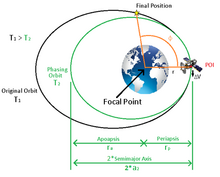
"If spacecraft is behind the final position on the same orbit, the spacecraft must slow down to enter a smaller, faster phasing orbit to catch up to the final position."
That's Counterintuitive!!! 

Focal point.png


A quick Video of me trying to figure it out and actually getting it WRONG but still finishing the mission!

Monday, April 29, 2013

GURPS Making Initiative Check Based

Initiative is a score that player rolls for his character where his margin of success and failure determines his order in initiative.

Initiative is Tactics roll with SPDx2 OR IQ. If the character does not have Tactics, they can default to -6, Strategy-6 or Soldier-4. Combat Reflex adds +1 to Initiative.

In the beginning of Combat everyone rolls initiative.

SPD 6.00, CR, Soldier IQ+2 has an Initiative-11
SPD 5.00, IQ12, Tactics IQ+1 has Initiative-13

Double rewarding SPD.
A smarter person may think faster and be slower in combat, but his physical speed will be reflected in Movement and Dodge NOT in the order in which he acts. Because of Wait maneuver a faster thinking character Waits and uses his faster thinking to Prepare and Predict the outcome. Of course if his prediction is wrong, he gets screwed so it balances out.

So a Faster Character may Act Fast in the sense that in the second he may travel farther and dodge better but it doesnt mean they can bring actions and plans online faster than a smarter quick-thinking character.

In GURPS it is not clear that the "start" of combat, those who have not acted is considered "flat-footed" like in DnD. You can still defend as though you came from a "Do nothing" turn in the very beginning of combat.

I like using the Core Mechanic through out the system when it is possible. Using a 3d6 Check for initiative benefits the bell curve and makes for some random variables in combat.

Saturday, March 2, 2013

GURPS Traveller Character Gen Side Project

Here is my Statement-Sized Google Doc regarding GURPS 4E Traveller Interstellar Wars Character Gen. Basically its all my homebrew rules and considerations regarding GT4E.

I really cannot edit documents on my Note 2 without screwing with the styles, and that is a pain in the ass to fix every time I open the document on my Note 2 with Kingsoft Office.

Features I hope to incorporate over time:

  1. Character Life Path Generation Style - I can roll randomly for my characters like in Traveller. The statistics are conservative since characters can't be too weak, as to give too many problems. when you have an exceptionally weak character, it is rare that you might as well try playing him/her.  
  2. Packaged and Randomized Background and Disads - this is a feature that will allow faster character creation, and a plug in system that uses Disads to influence the Events tables. 
  3. Optimizing Skills list and definition - updated for Transhumanist futures - the future complicates but it also consolidates, consolidating skills and the tasks you can use with them. Removing redundant and pointless skills is a Homebrew, too many options which should be using the Optional Specialty Rules, Related Skill Rules, and Specialization Rules more consistently shrinks the skill list.  
  4. An Events Table. Why the character shipped out or why the character chose a riskier lifestyle.
  5. Notes on Stealth-less Ship Combat.

Plug in notes I am DREAMING to Incorporate. 
  1. Notes how to run a Naval Campaign. include a complete Ships and Ship doctrine similar to Honorverse including, complete with tokens, maps, sample scenarios (if you just want to duke it out) and fleet building rules. I will plug in my Entity Game System so that people can play Dukes/Admirals. A simple Boardgame style system for ground forces encounters.  
  2. Notes how to run it with MECHS (like Mechwarrior/Battletech)
  3. Notes how to run it like Fading Suns or Dune
  4. Notes how to run it like a Warhammer 40k, Imperial Army campaign.
  5. Notes how to run it like a Kitchen Sink Setting (including the variations of a Anime Style Epic Campaign, like Naruto/Bleach).   
  6. Notes how to run it Dis-empowerment Campaign (like Horror or Cthulhu)
  7. Notes how to run it like a Cyberpunk Campaign

Thursday, January 3, 2013

Just getting a lot of ideas down


Recalibrating Classes and Some Rules
I was wondering about re-calibrating classes in 3.5. Breaking some tradition, and making more sense.
  • Breaking down the Cleric - The cleric is broken up to Divine Warrior and Divine Theurge. 
    • Theurge (which means miracle worker) is the cleric's spellcasting capabilities with d6 HP, 1/2 HD BAB progression, Good Will saves only, and Channels divine energy of a undetermined type (removing the positive and negative dichotomy). Subcategories of Theurge is the Contemplative (Prepared, like typical cleric) and the Inspired (Spontaneous, limited spell known and more slots - follows Sorcerer progression).
    • The Divine Warrior has more of the old cleric capabilities d8 HP, 3/4 HD BAB progression, good Fort saves only, and spell casting up to 6th level. Also follows the Inspired and Contemplative subcategories. can also channel energy but severely limited. They gain Feats every 3 levels after 2nd (like psychic warrior). 
  • Arcane Warrior - drawing from the Psychic Warrior and the Cleric and Divine Warrior. These have 3/4 HD BAB, d8 HP, good Fort saves, and feats every 3 levels after 2nd. There are two subcateogries: Blooded (Spontaneous) and Disciplined (Prepared Spellcasting).
  • Experts - Feats are like skills, they are still bodies of knowledge. Its wierd that the Expert doesnt get more feats. Give it Feats every even level, and you've got quite an interesting class. Make the HP d8, and good Will saves. 
  • Aristocrat and Bonus Feats - give the Aristocrat bonus feats ever even level, and Leadership and Courtier Feat options they become very interesting and fun to play with, even as a PC. 
  • Tactical Feats - i can make a bunch of Tactical Feats. the key points I have to work with are: Positioning, Enemy Strategies, allow the Player to gain bonuses if he predicts correctly the opponent's next action, improve or provide additional advantages when coordinating (better flanking bonus and bonuses to Combat Manuvers when coordinating with allies).
    • Ex. When Enemies are Defensive, like when they withdraw or line up defenders. if the Tactician's side has a greater overall movement, the Tactician presses the advantage giving allies extra moves in order to flank
    • Ex. If Enemies are Aggressive, like when they charge and rush at the Tactician's side. The allies gain better reactive and defensive abilities. A bonus if a readied action correctly predicts the enemy's action, better AC when allies coordinate defense, etc. etc.
    • Ex. When the Tactician correctly divines the enemy's action allow readied allies to make a Full Round Action against these enemies. 
    • and more...  
  • Social Feats - Detail the Economics and i can allow significant resources. This is only good in high lethality games where Numbers can pretty much determine the odds of winning. In a numbers game, the person who can bring more to their cause and side wins... hence it is important to have Social Feats. These include Wealth, Connections, Binding Oaths of Loyalty, etc... not just schmoozing, flattery, lying etc...  
    • Its easy to transplant a sound economic system, like that in D20 modern or GURPS into DnD. Feats become a type of currency to gain these social advantages, there is much machination in the background when someone hands you power so Feats describes pretty well how "connected" and cunning the character is in amassing such. 


Psionics and the Far East
I was wondering If I could find some chinese terms that would fit Psionics and their classes. I mostly uses the english equivalent of many of the Chinese titles, ranks, and nobility because... its hella' easier than learning the chinese one.

The idea came from making psionics an art of those in the FAR EAST. I can exactly use the "magical" equivalent in Chinese like Wu or the Daoist terminology. I was wondering if I could link it with Bhuddism. The Daoist using Divine magic, the Confucians with Arcane, and the Bhuddists with Psionics.

 I tend to set my game in the 11C, and in the Far East this is around Song dynasty. Plan to make the far east made up of 3 vying spellcasting elite: the Divine, Arcane and Psionics. Making the Conquering Horde "Psionic"would be fun.

Mountain Ponies
I like ponies, and I happen to be a brony. Funny thing is that Ponies in DnD are too weak, and there is not much allowance for stronger ponies. These Ponies with powerful build (doubles the carrying capacity of the pony). Double the cost of the Ponies. Mountain Ponies are sure footed and have +2 to balance or climbing related checks. The story I made up for these are that, dwarves use these. They are of the right size for dwarven stubby legs but have thicker bones without altering their build too much.

War Rams is a Mountain Goat, the really big fantasy kind. They are very sure footed and these were bred to be mounts. They have the stats of a Mountain pony but Heavy horse HD and Strength.

Mountain Surface Area.
Mountains have a lot of surface area, but they are not very productive. We've seen humans maximise the productivity with Steps to grow rice. I was thinking Dwarves combine Step Farming with crops that don't need flat terrain: potatoes or yams. Cultivated mountain have Taters and Yam steps, those with hot spring have thick bushy wheat and rice step paddies. Dwarves still import a lot of food, because it takes more effort to cultivate for them in the mountains than everyone else in their low lands. You can have a mountain with abandoned steppes, which is a great backdrop and shows the evolution of how dwarves move to more defensible and secure upper areas.

Tuesday, December 25, 2012

Back to working on GURPS MIddle Ages LITE

Looking at what there is left, I think it will be another 20 more hours to finish it. I need to test it and see if people will find it "complete enough".

The book is arranged in a way you can easily create a character that will fit Harn, Song of Ice and Fire aka Game of Thrones, or a historical game. I will have so add on docs for templates, lenses, random character generators, and load outs. Ideally following the templates and lenses, if the player takes a split second per decision ( because we know what we want) it should take 30mins. It would take an hour with the GM guiding the process.

Bringing down GURPs character creation for newbies to 1 hour should be a milestone. Even faster if you take away 90% of the decision making. Of course from 0 knowledge of medieval feudalism it would still take several conversations and maybe sitting in to watch Game of Thrones, Rome, or series of the like to know what you want.

Note to self
- add signature gear for "ancestral weapons"
- manor generation
- Warband generation ( the common large combat fighting unit ) a handout to be used with mass combat.

Note that I have some rules tweaks, which have a superscript of non-canon or non-raw.

Saturday, December 22, 2012

from 2010, Axial Age Setting and D20 based system.

I was really inspired to play or run a game set in the Axial Age. So I made a fantasy setting that is pretty much the great powers of the Axial Age to make it more appealing for people who are not into history.

I don't know what came over me, but I made a d20 based system which is roll below your stat (follows DnD stat ranges) as the Core Mechanic. I only need to draw heavily on D20 statistics and mechanics, but I expounded using Save Based Wound/Damage system, Work and Effort Mechanics also based on the Save-Based system. It was essentially a very simple system with 1d20 and d6s for character creation (for bell curve statistics). So much has happened that I can't remember what I did.

Part 1 Character Creation.
Part 2 Adventuring

The major inspiration was Kenneth Harl and Robert L. Dise Jr works for the Teaching Company.

Thursday, December 20, 2012

Finished D20 SRD homebrew Prep

It just need some polish, but it is practically finished. I was able to construct some characters and test out how the encounters can be deadly. They are deadly, as deadly as an L5R, GURPS, or SoIF. So ideally people avoid combat.

Level 1 characters are pretty formidable, even non-elite stats, if the players are not careful. The dominant strategy is to avoid combat or a terrain that does not favor the character a lot. Against greater numbers a PC can't just tank, they have to fight and move. They have to use terrain and mobility prevent swarming opponents. 

Orcs are an extremely effective opponent, too bad their limited vision at night and especially at day makes them poor archers. I'm sure they can do archery, its just that 60ft or about 20m is about throwing distance. Maybe I'll just get them point blank shot and make their dex better and not their con (+3 to attack +4 to damage). 


True Strike might be powerful in this homebrew modifications because it is a +20 but there is no called shots table handy. I've made some quick house rules and based it on GURPS statistics. 

Eye or Neck -20
Head and Extremity (hand or foot) -10
Limb -5

Mage Kights
Given how lethal this system can be, there is a feasible strategy of a Mage Kataphrakts (F1,W2). They can use Archery or Lances, charging against opponents and striking at high value targets. Its a Feat of Concentration to cast True-Strike while galloping allowing them to Hit a Vital and kill the opponent and move safely away.  

Setting Sketch
My preliminary Sketch of the world is like of the Dark Ages. The elves have a dying empire, they ruled over men and dwarves for thousands of years but political strife and invading terrors has weakened the state and economy. The Dwarves were their Federated Allies, inhabiting the buffer zones of the empire's core. Men have begun ruling former Elven provinces and providing levies and allied troops for their defense. 

Elves are the center of the economy that allows the Dwarves and Men to thrive. The Elves are made up Houses that produce magical spices and seeds that provide essential medicines, food that can grow in salted earth, and extend the life and quality of food. 

Giants, Orcs and Goblins come from the East, pushing west.  Where humans and dwarves are not able to hold, these creatures settle. 

Players begin in the setting Capital: Valentium but will be setting out to the East to meet the oncoming threat to the Empire. 

Wednesday, December 19, 2012

Ally or Contact - complexities of relationships

I was wondering about if one had only limited character currency what one should spend on, and I found allies quite interesting. How much can you tap from an ally? How much would an ally tolerate, and what kind of relationship is that if you tap an ally for a resource and how often does the character returns the favor.

This is one of those instances where players can act in a way that is unrealistic or socially in appropriate. One of my problem with this is that it sets a wrong impression and the danger of someone carrying that knowledge to the real world.

Having a friend in high places, has some very limited benefits - invitation to a great party or vacation you cannot normally afford (plus great company) but don't count on your friend doing anything that would making moochers out of his friends.

For starters, the GM should use allies as a source of plot and adventure hooks. These friends in high places will interact in a way where there is a limited amount of conflict of interest. He would help his friends with a lead, put in a good word, upper circles gossip and hearsay, provide insight about the higher ups of a institution (which speaks about the corporate culture - an organization becomes what it's leadership is like), etc...

As for the cavalry or being the big guns, financial backing, and some patronage power... That requires some detailing. characters is positions of power don't get there risking all that just for anything... His friends, the PCs, should consider how they might screw up the life of their powerful friend.

Definitely, when considering how much to spend on an ally (a peer vs a patron) consider how much of his own resources has the PC invested in himself. It kinda looks bad having invested more points in the ally than your self. The PC might become a retainer and not an ally.

Making your boss your ally - this is a conflict of interest. People who value their friends are in a better relationship if they don't trip over professionally their friends. Money between friends is complicated. Having experienced retrenching people and having been named in a labor complaint reinforces how this can be a really big problem.

Allies and contacts are complicated, the fast rule is use your empathy and your personal relationships as a guide. It's better to use them as adventure hooks, than for the players using them as resource you can just tap at any time.

Thursday, December 13, 2012

Updated my D20SRD Homebrew Rules

D20 SRD has

  • no power creep, 
  • accessible, 
  • easily define-able


You can find it here.

  • Combat is Lethal with Con being the arbiter of life and death. 
  • It is EASY to be hit. 
  • HP is Fatigue Points; an important Logistical Tool and for Spell Casting
  • Creativity and Detail allows characters to make surprisingly clever or lethal solutions. I allow called shots and 
  • Survival is a strategic challenge, as XP is from cleverness, RPing, and visualization. 
  • Low Powered Game but has a lot of milage. 10 being the highest level allows for Easy NPC creation. 
  • Magic  and Supernatural is Scarce and has a Role-Playing Demands (because of the detailing Codes of Conduct, Vows, etc...)

i plan to just convert modules for this.

Sunday, December 9, 2012

Ally followers black boxing

Other than the characters personal wealth, he spends points on allies, which are his followers. Allies that are followers provide manpower, independent income and special abilities or insight. I've oversimplified it in the game and clarified it.

So with a lord his primary asset is his revenue generating like a village, manor or city. He may not be directly managing it but he sets the benchmarks, goals and management. He manages the managers, so there is some basic IQ-5 or admin or merchant roll to over see the steward or chamberlain. Those other independent income sources, those he's delegated to his knights, lords, yeomen, etc... Are simplified as allies with 3 basic duties - manpower, duties/taxes/gifts, and their talents/insight/counsel.

I'll illustrate and simplify it in the GURPS low tech lite I'm working on. So a lord has a messy character sheet when it deals with his relations, in fact it is best mind-mapped. A lord will also have retainer experts and yeomen. Secular lords can even have religious retainers as wells as religious leaders have secular lords. This whole mess is great role playing and is actually realistic. But the key mental note is that these allies are black boxed. Maybe I'll make a stat block.

Note that to some historians, the church is the alternative career track for nobles. Most bishops and pontifs are nobles and have families. Some noble clerics try to build their own dynasties within their religious bureaucracy.

Well ill make the doc available should someone tweak this later on to be Han, japanese, Indian, or middle eastern centric, or more suitable for their setting like GoT.

Saturday, December 8, 2012

Another way to deal with GURPS Dmg

Average All Damage. This is great with fire-arms. Just apply the 3.5 per d6. Do the same for melee weapons, but melee weapons have "/" where the maximum damage is placed. Margin of success if is additional damage. You really don't have to allow the extra damage for melee, since GURPS is pretty lethal.

Now that there is a more or less static value for damage, there is one less roll per attack. Use the Character's HP and the Wound Instances (HP/2, HP*2/3, HP, -HP etc...) into "Conditions" up to the number of conditions relevant to your game. So you have Wounded (HP1-4), Major Wound (HP/2), Crippled (HP*2/3), "Bloodied"(HP), Dead (HPx5). These conditions benchmark damage (damage after all DR modifiers). So if a character takes a HP worth of damage it is a wound that would Bloody him.

Track wounds by listing down the wounds like "Wound #dmg type" it can follow with the note location and special effect.

To speed up Combat, I'd replace Active Defense with a penalty to TDM. The math is off the cuff. What happens is the character choose an active defense, and the score determines penalty. You can roll before choosing the active defense, as long as the one choosing the active defense doesn't know the value of the attack roll.

Active Defense Score, TDM to Attack roll
3-4, -1
6-7, -2
8, -3
9, -4
10-11, -5
12, -6
13, -7
14, -8
15, -9
16+, -10

Removing two points of reference should speed up the combat. The GM can set up some "defaults" like torso if no specific target is declared, best defense remaining or dodge if no defense declared. After the learning curve, combat becomes much faster.

Combat Metrics
No of Players
No of Units that make independent actions.
Units as part of a Group. Half minute per mook.
No of Exchanges (Players asking target nos. or clarifications)
No of rolls in the process. A Roll can add a minute worth of exchanges.

ex.
5 players, vs 20 mooks and 1 BB.
thats 6 people at about 6 mins per round worth of exchanges.
The GM handling 20 mooks can take extra long. That can take 10mins for the gm to resolve the mooks.
The GM does tactics and careful consideration of the BB, so he takes about a minute or two.
so far the total time per round is 18 mins per round. The mooks hit ability to hit determines the amount of time (% x 1 min). If they hit more than half the time, that means they are rolling damage at that same rate and trying to count beans. so if the mooks hit 30% the mooks may take about 3 mins to resolve. Making the round time 13 mins.
If they have a 90% to hit, then that means 90% of the time the GM is rolling damage. The GM is making about 18 more damage rolls and talkint to players telling their damage and all the other consequences.    

as compared to
5 players, 3 followers (90%) vs 3 striker mooks (90%), 5 tank mooks (60%), 1 controler mook (90%),
6 people = 6 mins, 3 followers = 3mins, 3 strikers = 3mins, 5 tank mooks about 3mins, and controller about 2 mins. 17mins each round.

If this GURPS, resolving the round is about 50% more time because there about an extra roll. if you add the random hit location rules, thats about double the rolls. that would be 34mins for the second encounter.

Ideally with only one roll; it would be faster than a DND round by a small margin. with practice it would be half (9mins). Preventing rolls in the system can be remedied by creating Consumable Cards (see using cards article from way back).

Thursday, December 6, 2012

Scratching that Pedantic Urge: Economy Sizes

I just got to get this itch: Starting Wealth is determined largely by the size of the Economy. Imperial Rome, in its height had a very large economy with a great surplus of resources for its citizens. This was the same with Imperial China. 

Economies are greater than the SUM of its parts because of Specialization. Specialization was a productivity multiplier, allowing the parts to be way more productive when each cog and wheel hit their stride. 


Pre-Civilization. (TL0) Pre-civilization is before city-building, and these economies were very immature and numbered in a few thousands at most. Starting wealth at 250f.

Early Civilizations. (TL1). This is when an economy first reached a million. Starting wealth at 500f.
Examples are
  • City States of the Levant
  • The Empire of Sargon
  • Old Kingdom Egypt
  • Kingdoms before the Xia
  • the Celtic and Germanic communities prior to Romans conquest.
Early Empires and the Great City States. (TL2) This is when an economy reaches the size of few millions.  Starting wealth at 750f.
Examples are
  • the Egyptian, Mycenaean, and Hittite Empires
  • the Greek City States,
  • Early Roman Republic,
  • City States after the Fall of the Roman Empire,
  • The Zhou during the Warring States period,
Kingdoms and Nation States (TL3). This is when the economy grew to tens of millions. When City States became more complex, assimilating more entities, and cultural identity was not limited to a City. Starting wealth at 1,000f. 
Examples are
  • the Roman Republic
  • Unified Greece
  • the Persian Empire
  • the Empires of the Qin and Han Dynasty
The Great Empires (TL4). This is when the economy grew up to a hundred million. It has reached such a size and breadth that a professional bureaucracy is needed. Starting wealth at 2,000f.
Examples are
  • the height of the Roman Empire,
  • the Empire of the Tang Dynasty and onwards,
  • the Empires of the Age of Sail  

Wednesday, December 5, 2012

Social Advantages requirements

Some advantages have a cost to maintain. Contacts and networks are something I am terrible at maintaining, my best bet of being better at it is if it ties in with my hobbies (LoL!). My dad is a good example, his hobbies are golf, wine drinking, motor biking cross country, men's clubs (like the rotary, makati biz groups etc..), fine dining etc... As compared to mine which are RPGS and airsoft.

Contact and networks are very powerful because of all the uncertainty, we do business with people who are vetted and whose background we can check. If the GM emphasizes this reality, then my character will need the same hobbies as my dad.

When I found out that a bunch of BPO country heads were playing paintball, my dad was telling me to join them... What a quandary - I'm part of a team, one where camaraderie is made up of bonds that is organically grown. Joining them is creating that user-user relationship, it will diminish my credibility (not that it is advertised or gets around). Right now I just can't, I'm afraid of the complexity it will bring to my life, at what may be a very negligible opportunity.

Like the maintainable of a game group or a team, social advantages have a cost. Even the ownership of wealth is scary - I've experienced a lot of theft of company resources. A reality I noticed not a lot of GMs point out, unless it's traveller and there is always someone out to rob you of your ship. Wealth and assets are a story of itself, without anyone trustworthy it's gone. I guess it makes sense why all these owners are talking about loyalty. I personally don't need loyalty, I just need honesty - I'm not offended if the person leaves for greener pastures... But it sucks to realize that they are leaving because they have stolen your leads and mean to compete. Business is not for the soft hearted, and there seems to be a low value for a good working environment vs money.

In reflection if some RL limitations, I'm thinking of adding a social cost to social advantages. Merely X no. Of hours a month equal to the Point cost. 1cp contact is 1hr a month, 20cp worth of contacts are 20hrs a month. Quality and competence modifiers don't count, at the same time the GM hides these details, resolving it like a save system.

Wealth has some hours guidelines, which I will follow more closely.

Sufficient to say, my social networks are only those in airsoft and freethinkers. I guess it's a blessing that it is not complicated by work.

Monday, November 26, 2012

Organized some text: GURPS Lite setting specific

I tried to reconstruct my GURPS lite that was specific to Low Tech. I've hit a milestone where I finished organizing the text, simply arranging the text from its copy/pasted form. Next is that I proceed to format it. I plan to integrate the Traveller career path system as part of it and some random advantages and disadvantages that are setting specific.

Basically a modular template to make my GURPS more digestible for newbies. Keeping everything in 30 pages. Knowing how my endurance works, I may do this after Christmas LoL!

If you want it, email me. I think this falls under fair use. I just can't "publish" it in public.

Saturday, November 17, 2012

Cards as an Organization Mnemonic


Using Cards

The cards are meant to concentrate and prepare details that are relevant. In a Top Heavy game like GURPS, Open RPGS, HERO, Chunkier version of DnD and other Games breaking down information in the cards acts as mnemonic that allows the player and GM better access to information and constructive problem solving. The information is not limited to be displayed in an 8x11 space, all the space behind the GM's screen becomes a plot organizes for before and during the game.

This is not for just the GM, this is meant so that the GM can assign players to do this for their characters. It helps the GM and helps the game.
  • Modes.
  • Load-Out.
  • Special Actions
  • Conditions

What you will need

These are 3” x 5” cards or ISO standard of A7. There are bigger Index cards and un-rulered index cards (being blank sheets). Whats nice about them is that they card-stock and are already pre-cut for your arrangement behind the GM screen.
You will also need a printer and computer, if you want to be modular with your information. Ideally a Doc Template for the cards, as well as good Doc notes of everything you are keeping track.

Modes

These are cards that describe the current status and attention the character is doing. It allows the GM and Player to automatically check regarding instances the Mode is relevant. If we were to go a bit about psychology, its a set of expectations the Character has.
Ex.
Scouting Mode – the character is focused in looking for threats and moving more quickly than his main party.

Hiking Mode – the character is more focused in optimal movement to energy reserve performance in trekking. The economy of his attention is focused on pacing, looking for best footpaths, hydration and the time.

Detect Lies or Credibility Detection Mode – the character is using this skill to vett a target person, to make an assessment of their credibility or the consistency. Anytime the target character is conversed with, the character keeps note of personality traits.

Diplomacy mode – trying to please and keep a civil discussion. (reminds me of the Techniques in TTC's Effective Communciation). The character is concentrating in controlling many intrapersonal, interpersonal, and diplomatically strategic points. Such a character would be very civil, polite, and keenly on the pulse of the social situation.

In these modes, the character is more predisposed to notice or react quickly to a specific set of expectations. The GM enforces economy of attention, and points out trade offs the players may or may not realize. When players or character try to do more than one thing at a time, the GM will note the diminished effectivity of their performance in their skills and passive abilities. It is in these redistrubtion players and the GM have risks and strategic objectives to consider. 

Load-Out

Character Load-outs when prepared allow the players to more accurately deal with the logistical challenges of the encounter. A character can have their combat load, their marching load, or their large, uncarriable, possessions as separate cards with their own notes and details.

Typical are a Civilian Load, what the character carries in non-combat or adventuring situations; Combat Load or variations of combat load (light, heavy, etc...); their uncarriable possessions like their mount, car, house, secret cache, etc...

Conditions

Conditions are a list of details that can be in effect on the character. These are the various status the character can be in: Wounded, Exhausted, Critically Wounded, various kinds of emotional states (Angry, Berserk, Demoralized), special psychological conditions that can kick in (Panic Attack, General Seizure, Etc.).

Special Actions

These are maneuvers  detail heavy techniques, spells, special abilities, and prepared combination of actions. Information in the card will include costs in actions, resources, and mechanics, and the trade-offs and consequences.

Card Tools to facilitate Narrative Combat

Narrative combat or high cycle rate events and activities (cycle rate: going through all the characters, cycling, many times) can be better adjudicated through Cards tools. The cards merely break down actions and reactions/opportunities. Having the cards help tracking the trade-offs of the character, in their condition AND in the battle field.

My problem with narrative combat, is that I don't have the mnemonic device of a tactical layout. Instead I have to keep track of actions and activities. Taking away the simplicity of looking at spatial relations when looking at figs; cards can help by providing a spatial relationship between actions and events. One of the advantages of figs is that, they easily relay information on the status and circumstance based on just a glance.

Example of Usage

Lay out where everyone is in respect to everyone else. The GM assigns values to every side: the GM's side can 12'o'clock or primary threat, the other sides as flanks. Players and the GM can determine how many layers will they stack against primary threat zone and against the flank zones. The GM can then place visible threats outside his Screen to oppose what the players have in each zone. Proximity and Card Position can show ranges and overlapping envelopes of access. You can use figs as paper weights (LOL).

Ex. Instead of Frontal Force you have one card with notes on visible no. Additional notes below the card. Flanking forces is just a card, unless the GM breaks out an autonomous/small force to do something else. Any prepared manuver is its own card.

Next is the GM assigns strategic points within the terrain (If any; i'll make a table to roll for various terrains) which he can use and draw into the zones. These zones are a Zero-Sum game; so its exploited by one or the other force.

The basic rule here is when elements add up, and the situation is becoming complex I should simplify and the break things down to elements up to 3. I re-abstact them back to 3 elements at most to keep things simple and manageable. The cards clarify the objective, while I adlibe/improvise what is happening without losing sight of the element's objective.

Its like Hyrdation – you do it because your conditioned to do it on circumstances that “feel” appropraite. When your confused, like when you are thirsty,  its too late; do it as it gets harder to track things. Like when “I feel this is getting more complicated – simplify and re-arrange elements back to back the primary”.


Open RPG Skill draft
Stealth
Intelligence or Wisdom
You are skilled in obscuring your position and presence. You still make noise but you are highly aware of what noises carry and what blends into the background. You can be seen, if the person knows where to look for you. You are able to see what route makes the least noise, maximizes a concealment and improves security to your destination. You are able to optimize the use concealment, and are very self aware what may be easily exposed of your person. You also know how to blend your visual wake with the movement noise in the background. The better you are, the more natural, consistent and reflexive your actions become.
Mode. Characters who use stealth mode, increase the difficulty to be detected by their skill modifier.

Thursday, November 1, 2012

Reflections on GMing after Simulations; Random Generating Flaws and Perks

There are a lot of ideas that come to me from converting my airsoft experience into GMing. One thing that just came up was, how Perception Checks should be handled.

My Captain has excellent perception, everyone else has average. from his description of how his perception works in GURPS its Tactics+Perception roll. He tells me that he uses a process of elimination going through all the best hiding spots in his field of vision. I've tried it and it really needs practice to get good at, but also it makes more sense than a raw perception roll.

My first time to play airsoft, and as we bring in newbies, confirms that there is a BIG default penalty. There is a -4 to -6 default penalty in seeing opponents in cover and concealment. Tactics+Per (or Soldier+Per -1) roll is not an option, its the only way to make sense of information overload. A high perception is not enough, you need to efficiently go through your field of vision as quickly as possible.

A person having at least 1CP or a familiarty will be much better than someone who doesn't know what to look for.

How to resolve Perception Checks with Group effort. 
- first players have to declare what they are doing, what they are paying attention to.
- the GM can roll the average of everyone's Per. The margin of failure tolerance is equal to the highest relevant skill+per. Its like having one roll and checking who would have made that roll.
- Filter who would have made it, by the relevance of their current activity. GM adjudicates, adding bonus or penalty based on their current actions - by how specific the character is looking for it. The more specific the better; the more general the more ambiguous the threat or data.
- This allows Van and Flank guards are able to react better; people busy with logistics worse; and fatigue penalty affects mental performance (unless one is a believer of substance dualism; then why does alcohol change one's behavior?).

These set of rules/guidelines allows me to fit what I have observed and experience, to in the game. Of course, players who don't clearly and definitely focus on what they should be focus would be a more unaware and flatfooted group.

Which brings me to why was a group of soldiers so easily ambushed in this show i was watching. EASILY ambushed.

I actually got "killed" in a game taking the time to tell allies to cross their vision and firing arcs. Talking and command is an action, I was in 90% cover BTW.

When covering 35' angle I notice I can catch anything that occurs within a second, any wider and my mental FPS is much slower than a second. at 90' i can be easily ambushed by a quick pop-up attack. at 180' even easier. This basic FPS rule, emphasizes the economics of mental resources. Unfortunately it takes practice for a pair or a group to optimize their alertness. If only there was a way to practice it without looking to weird.

In a GURPS second by second game, this would be an awful amount of detail. I run my gurps in 6 second rounds, like DND. In a narrative combat, as opposed to tactical combat, a perk should cover this, otherwise I'll throw penalites. When this mode of activity (room clearing) is on, players should be allowed to dodge or wait-attack.

Here is a funny side note about Keen vision in real life, it may be 2cp but if your asian it might as well be 5cp advantage. 70-90% of ethnic asians are near sighted. At least if your asian Bad Sight (mitigation glasses) is definitely easy to justify. What is weird is that in the Philippine Mil. Academy, you need unaided 20/20 vision (since Lasik is best taken in your mid 20s, when vision changes less)... that removes up to 90% of potential candidates(its modeled after the US, funny how it fails to take into consideration ethnic biological circumstance). 

Murphy's Rule makes me biased for Randomly Generated Characters. 

I see my RPGs as problem solving exercises more and more. It comes to the point that my bias towards some randomly generated characters are a necessity for the game. People really need to have the expectation MOST of the time they screwed by circumstance  but with in that situation their choices matter a whole lot more.

Its a head ache making a table for random disadvantages and advantages. That should be my first python exercise if I get around to it. a program that allows me to randomly generate a list of flaws and advantages for my open system.


Friday, July 2, 2010

DnD Magic With a real Cost

Looking at economics of energy, Magic in any setting throws away laws of physics for the sake of metaphysical and metaphorical unity. There will always be a game design imbalances to magic because, the human design will have a hard time making a "balanced" system compared to the Laws of the Universe as we see it in Science.

Still, some players ache for magic and if you want to play you will have to sate their hunger. As a economics nerd, the few ways I can comprehend magic if there was a cost. A real cost that would complicate decisions the ways organization and efficiency systems in the Real World complicates decisions.

In DnD3.5 i decided, what if magic costs 1 day per Caster Level x Spell Level at a minimum of 1. Defining it more completely, 1 XP expenditure on a magic Item is 10 days worth of life.

If Magic and all its certain and reliable power costs this much, how does it affect the decision making? One thing that it will certainly change is the Sh*t, Shower, Shave, Persistent and Extended Spell casting done by GISH characters.

What does Oldschool Gaming have to say about, making the 3.5 system magic cost so much?

Defining the Cost: LFD.
Since Characters are the Baseline, then I can define the cost of magic as Life Force Days. Every time a character casts a spell he loses LFD = to CL and SL. He loses an additional 10LFD per 1xp spent to cast anything.

It will be a natural strategy that some will try to gather as much LFD as they can when they can squeeze it in their ethical parameters. So its is important to define where can they draw up "life force days". In this case, any magical creature or creature able to take up a magical class. when their maximum age is indeterminable, then use their HP and double for every size category they are larger than human.

This means characters who want to "win back" or "store up" as many LFDs as much as possible.

Storing LFDs. there is no Storing LFDs, there is just getting more energetic and physical primed. I guess, I can translate it to Comeliness (average of Constitution and Charisma for me) having achieved the fitness at your prime (for me it was Early 20s). Over abundance can mean better Constitution and Charisma! A necromancer or a wizard who looks mature but as fit as an athlete.


Drawing and Sharing LFDs. Characters can volunteer LFDs to other characters with a minimum tax of 1LFD. All spell casters are able to draw LFDs from volunteering sources.

Forced LFD Drain. This is where necromancy and negative energy spells figure in. A being can only give up so many LFY before dying. If a creature takes LFY greater than their CON in a day, they start losing CON.
  • Energy Drain Effects Saps 5years instead of every level Drained on initial Hit. On a Failed Save, at the end of the Day another 5 yeas is lost.
  • 1hp Drained or Gained is 10LFDs gained/recovered.
  • 1xp Drained is 10LFDs gained/recovered
Death Knell allows the spellcaster to gain 1d8 x 10LFD
Vampyric Touch allows the spellcaster to gain 1d6 x10 (per two caster levels) LFD.
Enervation allows the spellcaster to gain 1d4 x 5 LFY
Energy Drain allows for 2d4 x 5 LFY

Cosmetics of LFD loss. Character's don't all of a sudden grow old, instead they appear more tired and haggard. Its mostly a hit on their Consitution and Lifespan. A character can appear in his 30s but suffer all the venerable effects, a few

Rolling back Time with LFDs. It costs Double the Recovered LDFs to turn back Physical Age. So in an instant the powerful spellcaster is supposed to get 20 years from an enervation spell, he can choose to become 10 years Physically younger. They can go only as far back as their Prime (look at Racial Statistics) Any farther means wont have any affect.

Optional Rule: Spell casters can increase Con or Cha, in at the cost of 1 point for every 5 LFYears gained up to +2 each! These are "temporary adjustments" and recorded in the Character sheets' temporary bonus scores.

Burning 1 Con AND Cha allows the character to gain 1LFY!

Multiple Ages. characers will be trying to get LFDs organized will notice their characters moving forward and back in their physical condition.
Character's Physical Age, since this is what is most apparent. (Real Age)

Undead. Animated with Magic, specially prepared Undead have their own LFDs. Upon Casting Animate Dead, the Caster chooses how Much LFDs to grant it from his "storage" or his own Life Force. Each LFD a Zombie can operate for 1 Day, a Skeleton costs 2 LFDs to operate 1 day. If they

Raising Characters from the Dead. Raise Dead costs WAY more, but is still possible. casting the spell has its cost in Life Force Years.

All these are ON TOP of the current affects, limitations, and costs of the spells.

other Abilities that Cost LFD.
All other sp and su abilities that mimic or just like a spell is as though the character is casting that spell.
Cleric's Turn/Rebuke Undead. Clerics HD in LFDs
Bard's SU abilities. Cost equals Skill Ranks in LFDs
Paladin's Smite 1LFD
Paladin's Laying of Hands HD in LFD
Paladin's Aura of Courage 6 LFD (casting remove fear)
Paladin's Summon Mount 6 LFD (casting summon monster)
Paladin's Detect Evil 1 LFD
Summon Familiar 30 LFD
Druids Wildshape 6 LFDs (like casting Alterself)
Thousand Faces 1LDF (Disguise self)

Monks - I decided that these don't cost any LFD since the SU abilities are so stretched out like Quivering Palm and Empty Body.

5th Level wizard with Int 15
4/4/3/1
4+20+30+15 = 69 LFDays if a wizard spends all his spells that day. thats 2 months of life force.

5th level sorcerer with Cha 15
6/7/5
6+35+50 = 91 Life Force Days!

5th Level Cleric Wis 15
4/4+1/3+1/1+1
4+25+40+30 =99 LFD

Casting Limited Wish
CL13*7 = 91
91 + 3000 (300xp x 10)
3091 = 8.4 years!

Casting Wish
CL17*9 = 153
153 + 50,000 (5000 x 10) = 50153 days
138 YEARS!

So a Human Wizard that has been able to keep his physical condition at 15 needs to burn his 55 years and another 83 years off from some source. Possibly a Rite of Sacrifice killing 4 other CON 10 people who willing volunteer it or when forced from some weakened thrall.

Long-Lived Races . Long lived Races can use magic more often, which screws short lived humanoids... or encourages them to enslave longer lived races for "batteries". One captured elf, will last power 5 lifetimes, if bled at a sustained rate.


Next Problem: ALIGNMENTS
Dnd without Alignments. What is so bad about players, who have to define their character's outside alignments? Well there is a bit more ethics and awareness of moral awareness required when looking at actions when there is no alignment.

mechanically speaking, spells and abilities that depend on alignment start getting complicated. it doesn't have to be, in my opinion. True Names can help narrow protection and detection spells a bit. Assassins, Paladins and Anti-Paladins become problems since the system has a black and white approach to actions.

Remove Alignment restrictions to paladins and they become pretty peculiar. They are a class that are accountable to the GM, an all knowing and being that will immediately act on any transgression. there are some serious thinking to do if there IS a diety, particularly when they depend on the worship of followers, are not omnescient, let tragedy befall both "good" and "bad" people etc. etc... There is so much rational baggage if there is an Omniscient person that makes everyone accountable to their actions that it makes the world predictable and unreal.

Remove the Omniscient Accountability and the patronage (which removes the magical abilities), and you have is a well educated fighter, capable of sorting out complex ethical and moral decisions better than the average person... something like Roy in Order of the Stick.

What can replace the Paladin's special abilities? How about ranger amount of skills (6 + int modifier) x 4. What happens is the paladin becomes the more educated figther, able to handle logistics, statecraft, and warcraft. A character formidable in court, among the common folk, as well as in the battle field.

Will this sell to players? Heck NO! only a total RP nerd will find this interesting. Remove the black and white and you have to think about actions more. This means no more: demonetization of opponents, players are required to make searching questions about the complex context of the situation AND WORSE, Empathize with their enemies.