Monday, August 4, 2014

GURPS Combat Notes 1: Basics of Maneuvers, Attack, Defense, Injury, and Grappling

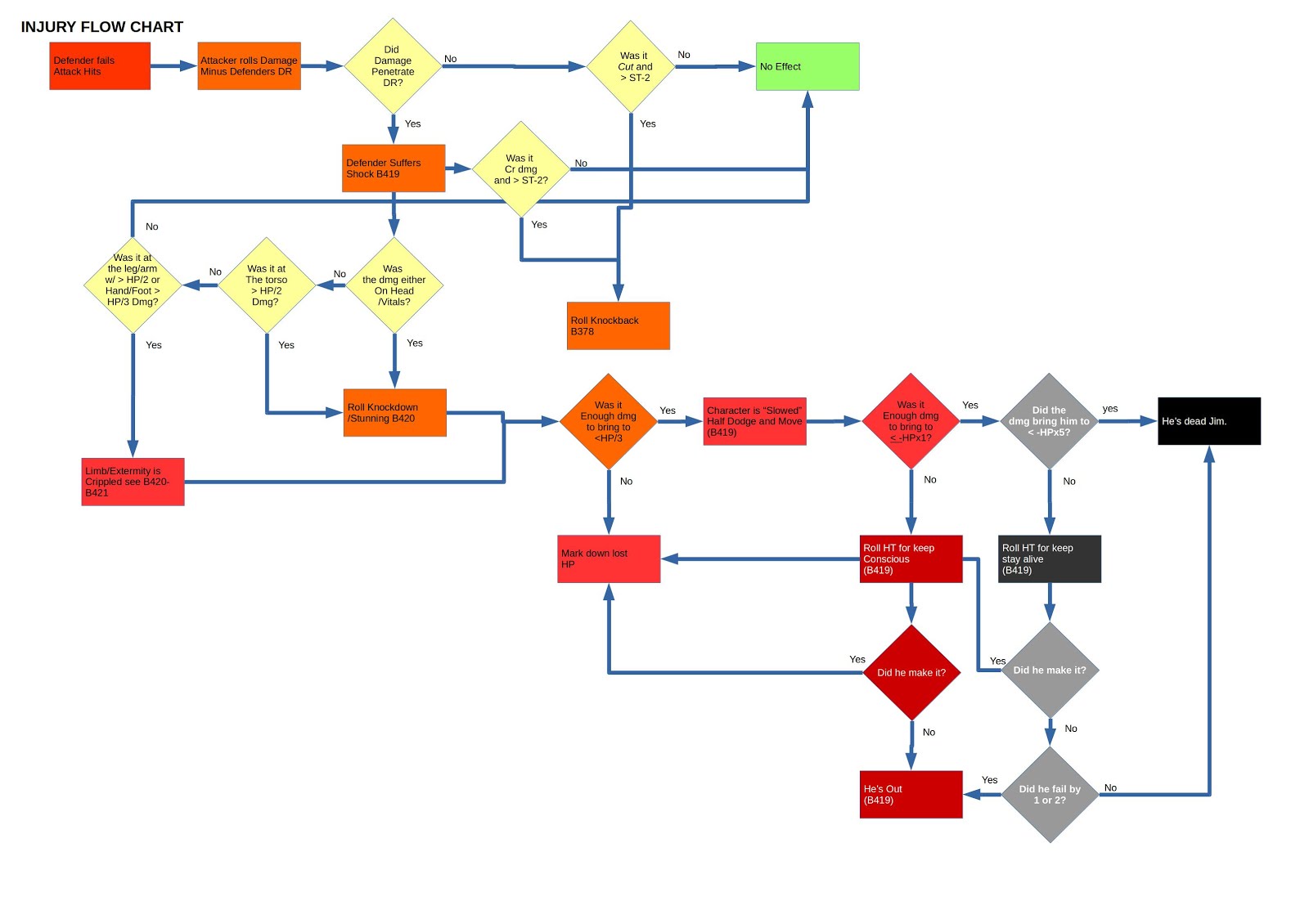
Disclaimer. This is a rather simple flow chart. Can you imagine if I added the critical hit, miss, and defense critical success operators?! Ok this should be kinda enough for newbies and a bit more. You can simplify it a bit more. I will make it available in my gurps teaching folder but note I'm a libreoffice guy.

Step 1 Choose a Maneuver

B324 (Characters), B363 (Campaigns)
  1. Do Nothing
  2. "Mental Maneuvers"
    1. Concentrate
    2. Aim
    3. Evaluate
    4. Wait
  3. Movement Maneuvers
    1. Move
    2. Change Posture
    3. Ready
  4. All out Defense
  5. Attack Maneuvers
    1. Feint
    2. Attack
    3. Committed Attack (MA
    4. Defensive Attack (MA
    5. Move-and-Attack
    6. All-out-Attack


Step 3: Choose an Attack Options

B369
Typically techniques improve a character's ability to execute an attack option. While there may not be a technique for every attack option, every technique is an attack option.
  1. Hit Location (aka Called Shot; B369)
  2. Target Chinks in the Armor (B400)
  3. Strike at Weapons (B400)
  4. Deceptive Attack (B369)
  5. Dual Weapon Attack (B417)***
  6. Disarming (B400)
  7. Rapid Strike (B369)
  8. Slam (B371)
  9. Shove (B372)
  10. Unarmed Attack Options (B370; B400)
  11. Feint** (B365)
  12. Horse Archery (B396)
**it becomes a combat option in Martial Arts, but its already a combat option in Basic Set under Feint and Attack, which can be broken down to Double Attack: Feint and Attack.
Roll and Shout - Feint as a Combat Option
***make it -5 instead of -4 and only against one target only if you dont have GURPS martial arts.


STEP 3.1 If Unarmed Choose the following Options.

  1. Striking (B370)
    1. Punch
    2. Kick
  2. Grab (B370)
  3. Grapple (B370)

STEP 3.2 Grappling Attack Options

  1. Takedown - (B370) force opponent to the ground (B371)
  2. Pin - (B370) while on the ground, force an opponent to a weaker position.
  3. Choke/Strangle - (B371) deal crushing damage
  4. Choke Hold (B404)
  5. Arm Lock (B403)
  6. Neck Snap (B404)
  7. Wrench Limb (B404)
  8. Strike with other Limb (B371, Actions After being Grappled)
  9. Non Attack Options:
    1. Release Grip
    2. Throw away Ready Weapon

STEP 3.3 Grappled Character's Option

  1. Attack or All-out-Attack
  2. Ready
  3. Break Free

Melee Attacks

  • B369
  • Target Size Modifier (B19)
  • Attacker’s Reach B402
    • Scaling Weapons LTC2 p.21
  • Footing (B387, B547)
  • Combat at Different Levels - penalty to defenses for inferior position, bonus to defenses for suprior position, modifiers for hit location making some harder while others easier (B402)
  • DR B46, B282
  • Cover B407

Ranged Attacks

  • B372
  • DR B46, B282
  • Speed and Range Penalties B550
  • Aim and Weapon Accuracy
  • Target Size Modifier B19
  • Cover B407

Critical Hits and Misses

B381
Critical Hit - B556 (30% improvement in damage or effect)
Critical Defense -
Critical Misses - B556 ()
Unarmed Critical Miss - B557

STEP 4. Active Defense

  1. Block (B374-375)
  2. Dodge (B375-376)
  3. Parry (B376-377)
  4. Physical Resistance Rolls (B)

STEP 5 Defense Action Options

  1. Retreat (for melee only) (B377)
  2. Dodge and Drop (B378)
  3. Cross Parry (MA121)

Combat flow Chart page 02.jpg

STEP 6 Injury

  1. Check Hit Location (roll random hit location B552)
  2. Roll Knockdown/Stunning B420
    1. If taking damage > HP/2
    2. if taking damage that can cause Shock on Head, Vitals or Groin.
  3. Check effects of Hit Location
    1. Hit location B398
    2. Effects of Crippling B421
  4. Shock penalty to DX and IQ B419
  5. Check General Injury B419
    1. < 1/3 HP remaining, 1/2 move and dodge
    2. 0 HP, roll HT vs Unconsciousness
    3. -1xHP Roll and every HP worth of damage, HT vs Unconsciousness and roll HT vs Death
  6. Other Effects
    1. Affliction (B428) ex. Moderate, Severe and Terrible Pain
    2. Poisons (B437)
  7. Optional Rules
    1. Bleeding B420

STEP 7 Mark Off Fatigue

B426

STEP 8 Fright Checks

B360

  • After the combat - if there is a grisly death (ex critical hits to the head or the character lost a limb) of close or strong relations, and there is a grisly death, or the loss of a limb roll Fright Check to see if there is Trauma and Mental Scarring (see fright check modifiers; fitting for gritty campaigns).
  • Characters with Post Combat Shakes immediately make a roll after any lethal combat.

+Steve Hartline made this audio flowchart with Quizelet.


Thursday, July 31, 2014

Learning Stuff Categorically

Learning stuff category helps for me. Like the confusing thing for me about Knockdown and Stunning checks.
Knock down and Stunning HT check is called if you take HP/2 in damage (aka major wound) OR damage to vitals. >
If you take Hp/2 damage to vitals the check is -5.
> major wound to the vitals like the skull and eyes the check is -10.

In the book B420 it would have helped for me if major wound was "under" Knockdown and Stunning. An Major Wound to Vitals was "under" major wound.

For me gurps combat is easier to understand if broken down to Maneuvers and Attack Options. Slam, Shove, Hit location (aka Called shot), Deceptive Attack, and *Feint fall under hit locations.

Maneuvers simplified into 5 groups.

  1. Do Nothing - Do Nothing aka "Pass"
  2. Mental Actions - Aim, Evaluate, Concentrate, Wait
  3. Movement - Change Posture, Move, Ready, 
  4. Defense - All-out-Defense
  5. Attacking - Feint*, (Standard) Attack, All-out-Attack, Move and Attack, Defensive Attack, Committed Attack
*Feint APPEARS like an attack, and should be under "attack". It should be indistinguishable from a normal attack. It would be simpler to assume it is an attack option and removed from the Maneuvers category.

Blue appears in GURPS Martial Arts.

I can simplify it even more if I base it on appearance - Do nothing is lumped into Mental Actions. Defense is in Movement. Explaining it to people that there are 3 Broad categories of Maneuvers is much easier than 14 maneuvers.

All the Attack options found in One list, neatly organized.

  1. Hit-Location aka "Called Shot"
    1. Striking Weapons 
    2. Striking Shields
  2. Deceptive Attack
  3. Feint (in RAW limbo, in many situations its like Attack option)
  4. Slam
  5. Shove
  6. Rapid Strike
  7. Unarmed Attack Options 
    1. Striking 
      1. Punch
      2. Kick
      3. Elbow Strike
    2. Grab
    3. Grappling
      1. Initiate a Grapple
      2. Takedown
      3. Pin
      4. Choke/Strangle
      5. Arm Lock
      6. Wrench Limb
      7. Judo Throw


Ok. this is just the tip of the iceberg and I think I'm going to have to hold some sample encounters for my new to gurps players. I go more into this in my Gdocs GURPS combat notes, I use this to improve my system teaching. 

Tuesday, July 29, 2014

GURPS Rules that can adhere to the Core System

The core system in GURPS is 3d6 roll below a score, which has modifiers. I sometimes wondered why not just apply to everything so that there is only one core resolution to remember.

Parrying Heavy Weapons 

in B376 This is a system resolved using 1d6. which is strange since there are HT stats for items in B483
Why not just make it an HT check?
the weapon "surviving" in 4-6 out of 1d6 is similar to the statistics of 11! but most weapons have an HT of 12, which complicates this. What you can do is that at 3x the weight difference, you can have a -1 penalty to the check, and every additional weight difference you can say the "weight multiplier after 2x is the penalty. So x10 the weight is -8!
Fine Quality adds '+2, wile Very Fine is '+4!

Reaction Rolls

B359 A successful rolls means you get a "good" result while any other result is a "bad" result. A good result is a 13-15 result while a "bad" result is 4-6 (B560).

GURPS Mysteries and Social Engineering has created variants and nuances to this. Of course if you have a different opinion you can apply your own modifiers to the "strategies" (each social skill is a particular psychological strategy; threats, promises, and cognitive biases). This, I think, is really where Opinions of various GMs matter and various Cultural Awareness kick in. The negotiation strategies and practices of various Business Cultures come time mind.

It saves time to just make an Adhoc Reaction Score in a given situations. Typically or in Most occasions a pretty low score. Apply the reaction modifiers, and of course there should be a penalty to "strangers" or people you just met or (a penalty that is about -3 to -5) .

Instead of the B359's system you can just apply the Margin of Success of the social roll to 10.

This is where rolling 3d6 rolling high is good. Which is strange because you can easily make it the same. You can just make reaction rolls Quick Contest and the margin of success adds to 10 which you use to compare on the Reaction Table. A margin of failure, is a negative modifier to 10 which is

So if you roll very good, with a margin of 4, then your score is 14 in the reaction table.
If you roll bad, with a margin of 5 failure, then your score is 5 in the reaction table.
VIOLA!
It even allows you Quick Contests of Reaction Roll, when you are trying to win over a 3rd party.

Regular Contests

in B349 Regular Contests is not something that is used often. Its often overlooked and can have very rewarding uses. My Opinion is that it adds drama if Modifiers or Strategies affect the outcome of the Regular Contest and the Information is Asymmetric!  This means that participants have uncertain idea of the modifiers the other participant is gathering for the contest.  

This is basically how many social situations are modeled. 

Regular Contests with Multiple Intervals

This is not in the rules, but its a small expansion to them. I can have multiple Intervals to my contest if the PCs can change their strategy or factors change in every interval. In this case the Total Difference of Margin of Success determines the winner. 

Many things can be done in this method. Note that you can change strategy, that means each interval can be an adventure in itself where the outcome weighs heavily on the odds of the PCs. This is a great challenge to see the strategic and planning ability of Players, especially to check how they hedge their risks and how pro-active they are in turning the system on its head.

Examples of this is Lobbying Socially, where groups are exerting influence on a 3rd party. Another is Economic Competition, like merchants competing for market dominance. 

Wound Threshold System

Wound threshold systems basically a different kind of abstraction. Basically instead of using Damage or HP, you just simplify it to the Wound Conditions. HP becomes a "threshold" or a benchark for damage.
Weapon's Average Damage plus Margin of success to Hit minus DR. In another perspective its basically making Regular Contests of Abilities but in a number of intervals (those abilities is damage and toughness).

The simplest Threshold System in GURPS is just to use HP as threshold. Instead of rolling Damage, just add attack's margin of success to the "average" damage of the weapon. Call this value the wounding score.

If there would have been damage multipliers add a bonus to the wounding score.
x0.1 -5
x0.2 -4
x0.3 -3
x0.5 -2
x1 (no modifier like crushing attacks)
x1.5 '+2
x2  '+3
x3 '+4
x4 '+5

An attack with a broadsword with 1d+4 cutting would be 7. 7 + Margin of Success. If it was at the neck where cutting attack becomes x2, add 2. An attack with a MoS of 4 would have 7 + 4 + 3 = 14 wounding score.

The defender resists with his HT + DR + HP/2, call this the Toughness roll. His HP determines his Major Wound and the damage threshold of limbs. These values determines the margin of failure that would result in his condition getting down. Edge Weapons Blunt Trauma doubles the DR of metal armor against edged weapons.

HT12, DR4 (fine mail), HP13 would be HT26 minus 14. Defender has to roll vs 12. If he succeeds there was no damage. If he fails and If his HP is 12, his wound need to fail by 6 to go down on any but a hit on the limb cripples or destroys the limb.

A regular failure is a "lesser" wound and shock penalty equal to the margin of failure up to 4. Every lesser wounds give a -1 penalty to DX and IQ (this applies to Will and Per, and Self Control). At -3 wound penalty 1/2 dodge and move. Beyond -3 or 3 lesser wounds, a combatant can keep fighting if they have a margin of fail equal to HP/4. Otherwise they are down. Greater than HP/2, they are dead.

Even if the defender makes a toughness check, if the margin of success less than or equal the DR, the defender has a "scratch" (if it breaks skin) or a "bruise". Scratches and Bruises add up, when they reach up to half a major wound, their combined effects count as a lesser wound. Poisons can be delivered through scratches.

Critical hits typically have a margin of success of 10! So on a critical hit the Attacker would have dealt 19 wounding score and would have needed a 7 to resist.

In the end you track only the "really" lethal blows, filtered by HT, HP, and DR.  Each Attack instance is a Quick contest against the Toughness of the Defender. The scratches dont really come to play unless its a BBG or monster with a lot of HP.

Monday, July 28, 2014

When PCs are Leaders and they deal with Kings, Armies, Bureaucracies and States

TL:DR - you still have to do important stuff yourself - you cannot delegate the most important jobs. This becomes more narrative and requires a basic concept.

Work inspires me to game, or more accurately, it frustrates me in so many levels that I really love to escape to the game. Still it is my source of inspiration, insight, and ideas. One idea that seems not to be accessible is that - higher up the food chain you still have to do things yourself. Of course you can pick and choose your challenges better, you can allocate that epic agent for infiltration, you can send your armies, you can mobilize your entire economies... but in the end of the day the only person who you have the ability to predict what is going to happen is yourself. 

Your army can fail, worse - get turned, captured, or destroyed. You spy can fail or be turned, or was actually a double agent. Your generals can turn on you, while you delegate on an important task (happens a lot in history), your Bureaucracies can be a mess, your economy is really not under your control, and there is nature, and your Enemies. If your GM enforces fair manpower limitations - that Awesome people don't show up ready to be employed under your command (and mostly people who "say they are awesome" but are actually crap or worse - traitors), then you cannot just get rid of them (as Alexios Komnenos case was a great example - so many traitorous generals and he cannot afford to kill them, frequent assassinations and betrayals). 

The only people you can count on is your "TEAM". Although your team is not like what they used to be, fighting side by side. Instead each PC has a small staff which is Role-Played by the other Players while their PC is off doing something. All Players are in the scene, but in different characters. One character has to negotiate this, spy on that, lead this army to this, ready a city for that, etc... 

In the end, the GM goes through Each Scene, and through each player playing their part. Of course in some scenes some Players are controlling the more Powerful PC, but everyone gets their turn in the spotlight. The same way we wait our turn to act, we wait our turn at the spot light. We wait our turn, but the GM can make our wait interesting by letting us affect the scene through Allies that we can take control. 

Format or How this Works


  1. Basically the GM reviews mentally the entire process. Diplomatic, Logistics, Administrative etc... Its that intimidating because the GM's mind just swooshes past the entire process and sums it up. There are many variables in every process and he just arbitrarily (or based on the character's weaknesses) introduces challenges that typically comes up.
    1. Ex. A weak diplomatic corps but competent Military. This can present problems such as the risk of your diplomat being turned or losing focus on the leaders best interests. Lack of personal initiative or resourcefulness. Etc... Even if the Diplomatic Corps is lead by a PC, and the other Player play the NPCs staff there are tuns of problems that can going on. 
    2.  Ex. An Army on the March, Marching Discipline, Weather, and Problems with the Locals can be the mini-adventure or challenge within this side of the game. Again the leading PC, and minor PCs representing the other Players 
  2.  The GM moves back and forth. Even if the players are aware of things they should not be, the GM can always adapt things and expectations. If the other players learned of a spy in the army or diplomatic corps, or in court the GM can just say - you learned the spy's name. I wont say to maintain assymetry but I will guide the actions of the character who knows it OR he can just present a hard penalty to detect motives. Always giving the impression of a red herring can help players choose the best economize their characters time. 

Economies of PCs Time. Simply adapt the Multi-tasking penalties or Rapid Strike penalties to a situation. One task and every additional task is -2 (from Spaceships Multi-Tasking).

In hindsight, I think I should have made a flow chart for this (although it is more time consuming). Anyway, if there is a demand for a particular modular process I'll make it. I guess its some Economic Rules of thumb people can fudge of make assumptions to model how large and complex organizations interact (some Psycho history lolz)

The Campaign, Sins of The Crusades is a publicly view-able game and learning experience in running such games. 

Wednesday, July 23, 2014

Wounding Rules

I don't think I need to site any argument against HP systems, and the cognitive (and assumption) disconnect about it. Its really a poor model, when compared to other models given the increasing amount average amount of medical and health science people have in this day and age. This is not a debate about HP systems, but alternatives which I proceed to give examples of other systems and what I happen to like about them.

A lot of game Systems use HP. Few, strangely, give Tiers of Conditions or Modifiers to the condition of the character from the extend of the damage (ex. Fading Suns and L5R and Traveller to name a few; This kind of system is called a "Death Spiral"). Fuzion and Hero are HP system with some quirks like the Stunning and lethal damage.

Wound Threshold or Wound Save system is simply a check/roll against Damage (more damage the lower chance of success) modified by things that define "toughness". WOD, Savage Worlds, and some D20 variants use these rules - I happen to think they, Wound Save and Thresholds, are the most elegant wounding rules because it can be translated so easily to many systems and allow you multiple assumptions where you just adjust benchmarks back and forth.

GURPS is a hybrid of Wound Threshold/Save system and of HP system. You check against the amount of damage (in essence you have a damage threshold) until you reach an amount of HP damage that physically (the system assumes in certain conditions) is Impossible to survive from (in GURPS its HPx6 to HPx11).

WH40k is a bit of a mixed HP system - many other stuff happens when you get damaged. Its more fun when you automate the statistics instead of checking on the book (memorizing it is not an option if this is not your system of mastery). You can generalize that Systems with Tables for Damage and all the conditions it will result is a Mixed System for HP. There are conditions but you have to consult a table which is tedious and best automated in an app the GM can just click IMO. To stress this more, try to time your game referencing and look at the Opportunity cost of checking such references to Playing. This method of analysis works in other aspects of games if you can record and measure them, the time you spend on something and if there are better uses of the time that will bring out more fun. 

In GURPS marital arts there is a more lethal "death spiral". Although I don't use them because, I find just enforcing the half dodge and movement rule already lethal (all your enemies are more likely to do Telegraphic Attacks) when you apply simple tactics and I find it additional book keeping. I learned in airsoft, when you've hit the wall everything goes down hill.

Its pretty easy to port the Wound Threshold system and the Death Spiral into many systems if you don't like the current system. You can port GURPS hybrid threshold HP system to 3.0-3.5 DnD (shock penalties, Fort saves when taking large amounts of damage, and a bit of a death spiral). In fact you can take a mechanic from any game system and translate it to another if you can understand the basic statistics of their success rolls (which is why I have a hard time with systems that use a lot of dice).

Wound Threshold System

Simply Take the Damage and use it against what counts as Toughness or Resistance to Damage, what is at stake is the Condition of the person or object taking the damage. The Damage can be static and the Defender roll their Toughness/Resistance or vice versa. Note that the more only one side needs to roll (player vs GM) the faster things go. 

Damage can be a Margin of Success of a Hit, to show their correlation. Armor affects Toughness and so are other intrinsic conditions and qualities. You can have classes to represent various rock-paper-scissors situation in wounding (Rock beats Scissors etc...). 

In GURPS I made damage as a Task Difficulty Modifier, affecting the Defender's Toughness roll. In D20 it can be modified  Fort Save vs a Static Damage number. Note that toughness being the variable can replace variable damage, Margin of Failure is important if conditions have multiple tiers. So a very bad failure can bring a character down multiple tiers of conditions. 

Ideally the players need to bring up their Attack to inflict more damage or add more conditions that will make it difficult to save against the Damage if they are gaming the system. So what was typically adding more damage, becomes increasing the damage options. 

Hit location like legs, hands, feet etc... can create damage conditions. These conditions modify the Wounding System with lowering the chance of Saving against the damage but limiting the conditions from Death to incapacitating the Defender. 

I just learned while writing this creating a blank Rules Template for this would help... but given how niche this is I'm better off making more token drawings. 

Damage Class and Wound Systems. GURPS has a very simple damage class system - which is scaling damage in 10s, and hundreds. Wound Threshold system can also have a damage class, a modifier to a "class of attacks" that are really far greater or for weaker. Small creatures can have a Damage class, a modifier, to all its attacks making it weaker against larger opponents and you can have a damage class against Fire Arms or Weapon batteries!

You can create a damage class system based on any arbitrary value, technological leaps in protection and damage (like in War Hammer and Rifts), and simply looking at all the damage scales in your game system and grouping them to simplify.

Note that the Wound Threshold System, Death Spiral, and Damage Class or Scale can be applied to in animate objects.

So the search for a better model, and a model that is easier to implement (less points of potential failure or disaster), goes on. This compulsion only applies to some, and those so thoroughly afflicted create heretical constructs derived from many systems "hacked" together to create a monster. Their games run smoother, with a dangerous edge while the GM can pull levers and press buttons that create special effects that dazzle and maintain the powerful illusion of the game and its world.

Disclaimer: Experimentation leads to Hersey, Doubt, falling outside the Norm, and a disruptive behavior. For your social comfort and stability do not experiment without the supervision or permission of an Authorized and Certified GM. You will comply.  


Edit: Notes from Comments:


  • Dice Pool or Value Pool System - in Tunnels and Trolls combat performance is by rolling a pool of dice that is then distributed - allocated against an opponent or opponents. This creates wound conditions for those who "lose" against the higher value.  I forgot the system, but I played one with Dice Pool that shrinks as one takes wounds - I think its Aberrant or some WoD system. 
  • Not all HP systems are the Same - Some HP systems are very limited. Fading Suns and Qin The Warring States have a HP system that averages around 10 give or take 50% to double (and sometimes more). Some are a lot of points like in DnD. Some is Mixed like in the early Star Wars D20 with "Vitality" representing Gygaxian HP and Con being the "physical" HP. 
  • Soaking Systems.  Some Alternate to HP with a few Tiers of Wounded conditions use Soaking Systems like WoD where Damage is "Soaked" up by Toughness or The Endurance Stat equivalent. Failing to Soak is damage and you track it like HP. Some systems are more lethal, others can be dialed up or down in lethality. Soaking Systems are not so different from Any System that lowers the Damage or makes damage the equivalent of Checks creating a Binary Yes or No if the character is wounded or Not.
  • Narrative Control. House of the Blooded is the only system I got to play that uses Narrative control for damage. if you beat the guy (there is a wager system, a kind of dice pool penalized as you want more and more narrative control, more opportunities to declare facts) you declare what you do to the opponent. You can declare one "fact" like Killing him, but if he also makes a mistake, he can also say the other guy Dies of his wounds. To say I killed him and Survived is two facts, while the opponent can also say he survived (restating a fact does not cost any "facts), but is imprisoned for the murder. etc... 

Edit: the Few Systems I know (will update)

  • Qin TWS - HP with Death Spiral
  • L5R - HP with Death Spiral
  • GURPS - HP with Thresholds, and various penalties. Optional rules for gritter and more dangerous Death Spiral. 
  • Hero - HP with non-lethal damage and Thresholds. 
  • Tunnels and Trolls. Damage is from values rolled by a Dice Pool, reallocation of the value per opponent afflicts Wounding Conditions 
  • War Hammer 40k - HP system, with Critical hit Tables. These tables act like variable conditions. 
  • DnD 1.0-5. - HP system. In Later version  with various damage conditions
  • Harn 3.0 
  • WoD - Mostly the Core system uses Damage Soak, with a Few Wound Tiers (which can be viewed as HP)
  • Traveller Classic to Mongoose - Stats as HP, Death Spiral from Stat Loss. 
  • Fading Suns 1-3.0 HP system with few points, with death spiral. 
  • D20 Alternate Rules - Wound Threshold with improving Toughness Saves. 
  • House of the Blooded - Narrative Control
  • Mech Warrior / Battle Tech - (will review)
  • Rifts (and Many Palladium Games) - HP system
  • Dungeon World - 
  • Dead Lands - Wound Saves/Threshold. 

Monday, July 21, 2014

Terrain Evolution

Experimenting some more. These are Gifs of 128x128. They average 10kb. At 256x256 they average 30kb as gif and 90kb as png. I'll be sticking to gifs more to run the game smoother. 
They look more and more like BIT art lolz. Which is not a bad thing. But to optimize memory going to Gifs and limiting the color pallet is needed. 


Newer Versions of Terrain

Tree, bad footing, and bushes. 
Roots give bad footing. so hexes without roots have no penalty.
Bad footing Terrain and Bushes both give bad footing penalty, worse penalties in the bushes but they provide concealment and break line of sight. 

5.5kb
4.8kb


2.5kb