An interesting look at Ravenloft's falkovia with Medieval Demographics Made easy.
Population: 60,000.
Note that if you look at the population breakdown this is merely the Urban population added up. The urban population will let you deduce the total population, because you need enough villages to support more complex communities like towns and cities. At Dark Ages you can peg the percentage of urban population at 2%, at Middle Ages 12-13C 2.5%, 14C 3%, and 15C 4%. I would like the technology to be Carolingian, puting the population at 3 million.
Area: ?
Some sources describe it like Germany, while others compare it too France because it is the bread basket of the Domains. If you look at the map, it is heavily forested, so I'll go with Germany population density. That would be 30 people per sq km. That would be 100,000 sq km.
At this size many of the maps, which appear to be around under a 1,000 sq km must be scaled differently. One has to imagine that around every key settlement there are hundreds of small villages that line the longer roads and dot the larger landscape.
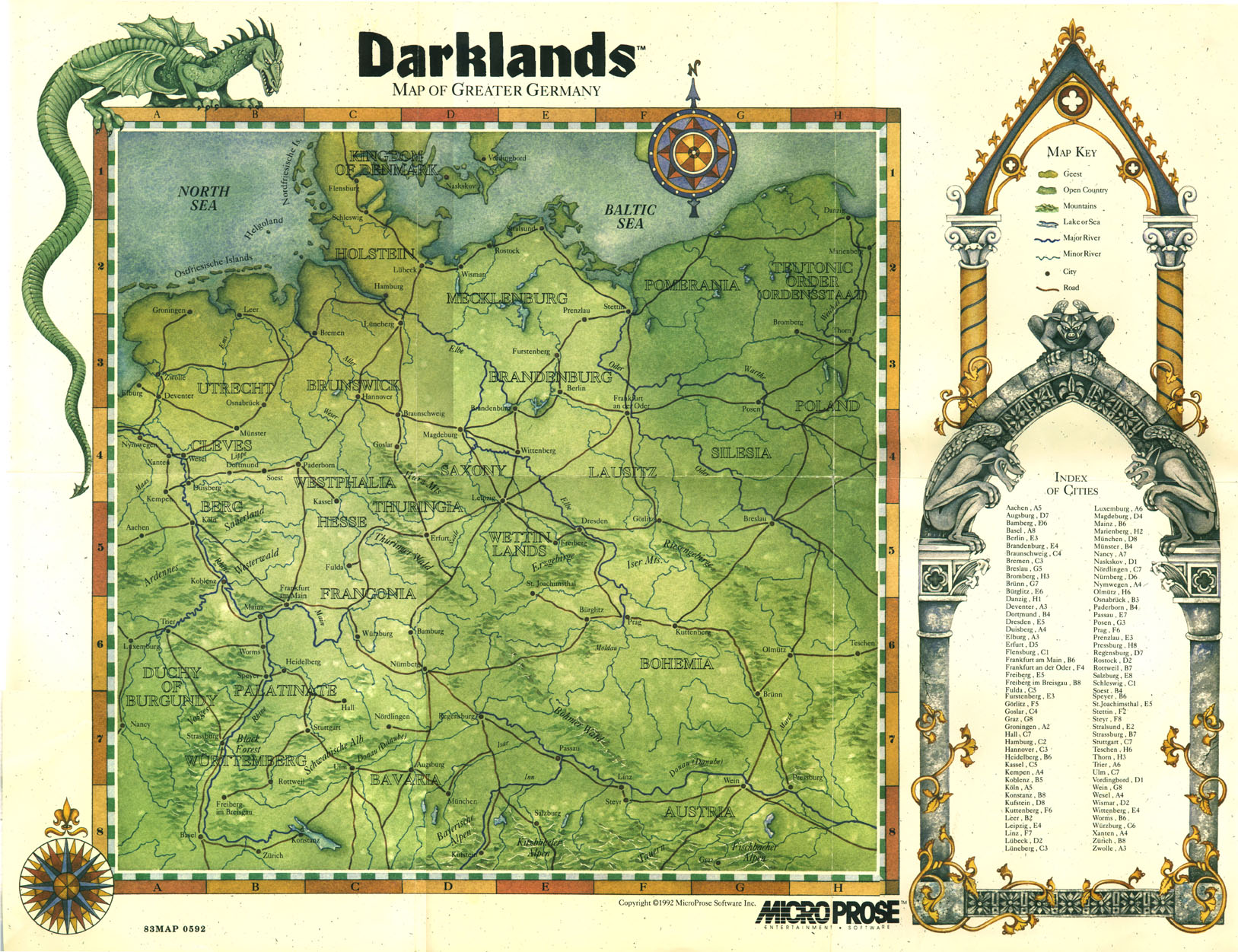
100,000 sq km is the size of 1/3 of the size Germany. Given this perspective, grab the old Darklands Game map of 16C Germany and re-imagine 1/3 of the area as Falkovia.
Government: Military Dictatorship
There was no such thing in the medieval era as military dictatorship because the military was built into the ruling class. You would need to seperate the military from the state to create that definition.
What you can quantify from the population, the neighbors, and the factors surrounding Falkovia and what you have is a seriously Military State, like that of the Spartans. Note that the Spartans were a warrior class. This will not work if the "despot" is the mercenary Vlad Drakov.
Vlad Drakov is now commanding a population comparable to the old Holy Roman Empire. Given that he is surrounded by undead and is in a constant state of war, he has enough political will to organize an military state similar to that of Israel.
One thing about the military that doesn't have much of an oligarchy is that it has only one way of putting people in positions of power: meritocracy. You can't afford an ineffective and corrupt ruling body when you are surrounded by undead. You cannot hold a state together with such people.
Re-imagining Falkovia as this Germanic Military State that is fairly egaletarian sets some interesting consequences.
Trade: Bread basket
You cannot knock food production. A military state that has a high food production means that it can field a larger army. Although having a larger army requires a different approach to organization and equipment. Your average joe in Falkovia is much like a roman soldiers, a highly trained professional that retires to farming with a household of cheap labor (non-human slaves).
Having more grain than everyone else means you can also field better or more horses. Since the man power size is much greater and a effective egaletarian state would rather to distribute than gamble so much resources on a elite few you then have a high amount of rounceys, warponies, and work horses distribution.
This would make further sense since many of the farms would need the heavier rounceys serve a dual purpose as work animals. Villages would naturally pool resources for draft animals, because given that the are no nobles that require huge stocks of grain to feed heavy warhorses.
Condition: Poor
Actually for what is supposed to be the only non-magical area and people in all of the Domains a greater level of organization, initiative and Identity is needed for Falkovia to exist. Such traits cannot exist without changing the status quo to encourage such behavior: thus they would more likely have a strong working and middle class.
Since non-humans make up the poor, most Falkovians come from a fairly comfortable culture that requires a lot of initiative, organization and hard work. Fighting undead, they need a lot of will and values that create an identity.
Having a cultural Identity and control over your destiny makes a people very progressive.
Re-imagining a Falkovian.
A falkovian can be appears like an eastern European, with a rich military tradition, and a strong sense of community. The strong sense of community that can be observed in the medieval English as they slowly became the superpower of the High middle ages. Although you have to color that image with a greater soldiering culture.
Many serve and many still serve in a rotational basis. A culture brought around a "spiritual" reason to serve the Dark Lord Vlad, for country, their loved ones and their brothers in arms.
Because of the causalities, large families are in style. The state and villages help out widows. Now and then rare women get into the action. Their status compared to men improved compared to other regions because of the man-power demands.
Communes will come into great use for effectively raising children and preparing them for the psychological challenges of their future. Probably an initative of the state.
The Falkovian Forces.
At 3,000,000 you have 20,000 career professionals. You will have roughly an additional 40,000 rotational soldiers. In a worse case scenario Falkovia can draft another 40,000.
100,000 fighting force. At 3% you have a fighting force relative to the population is not so bad. If you go to look at some-place like North Korea which have 5% active military, 20% reserve, and up half their population fit for military service (another 25%).
Every village will definitely have a holdfast or some basic fortifications. Small and highly coordinated platoon groups (6x6 + 4 officers + 20 baggage and reserves).
Running this Falkovia.
This falkovia will be quite interesting. I would enjoy imagining how such a state and people can fight undead like those of Left 4 Dead: fast moving "zombies". They will have to have different tactical formation, but the imagery of a cohesive military force bracing against charging zombies is quite exhilarating.
Formations, Tactics and Techniques against Boomers, Tanks, Hunters, Witches, and Smokers would be interesting to see.
There will certainly be a need for mixed group of skilled crossbowmen (using composite crossbows) and archers with broad leaf bolts/arrows. Javelins designed to slowdown charging "zombies". There would be a special Tetsudo/Tortoise and Pike Hedge formation against the zombie rush. Pikes will have stopping crossbars and hacking swords will be common.
Witches and Tanks will certainly be problem. Tanks are slow enough for very powerful and slow crossbows might be useful. Witches will certainly need keen fire organization and superior coordination with heavy infantry.

A Meta Gaming Blog talking about How to Frame Narrative, Exploiting and Exploring Biases, and Using Work Productivity and Motivation tools in a TRPGs most of the time.
Friday, January 8, 2010

Numbers tell a Story
Having a better a appreciation with Demographics and Numbers have given much inspiration for drama and the human condition. I've been reading up Poverty playing with Gapminder. Numbers clarify so much of the drama humans face. When you look at a poor country like the Philippines, seeing a shanty town may be a strong visual input but when you learn to understand the numbers it adds layers and layers of information that give another thousand words to that picture.
A family that suffers from the classic case of hardship, lost opportunities, and tragedy can be observed and counted. Numbers repeat that same similar but different story over and over again. Imagination takes over when the numbers begin to teach you that the tragedy is not isolated and it affects everyone and everything around it in different ways.
Instances and actions have subtle consequences that escape us from seeing the bigger picture. Killing 10 castle guards means 10 families will suffer in the winter. Oppression, Ignorance, and Abuse are reflected in the numbers.
As a GM I'm a story teller. Learning demographics and the science has changed my taste for games and stories. I have the experience to know what conditions create these dark and tragic stories we tell in our tales, thanks to science.
In the Basic Reproductive Health battle going on in Philippine Politics, the amount of scientific data of the observed and proven need for this legislation vs the Influence and Power of the Catholic Church is another story told by numbers.
Numbers are not some arcane language only mages can understand, anyone can understand them. The amount of lies people tell and the actions they do in the name of their belief, ambition and fear is another thing numbers bring to light. Numbers allow us to count the cost.
I know as a GM and when I make my own material I don't really need to go into the detail of what is poor, suffering, abuses, and causalities; but if I want my players to understand the scale and scope of what they are perceiving numbers is another tool that helps my narrative.
Warlords that have triumphed cripple their enemies to make sure they never rise up again. You walk the streets filled with pox rotting men mutilated and begging for food. You realize the human cost of a tragedy that is infused in the background and it reaches out to color the character's psyche.
A soldier that dies, could mean the survival of a family. Enough people die, could mean the survival of a village or a community. Enough casualties can mean a man made famine. The consequences are as certain as the numbers that allow us to observe the phenomenon.
Its nice to know one of my new nerdy hobbies is helping enrich my GMing.
Thursday, January 7, 2010
Thread Titles
Title threads with exactly the (boiled down) question or idea. No need to declare newb-ness or any other matter. Consider that when the thread gets answers people will have an easier way to find it in the future.
People are nice and even the most seasoned Gamers ask for some basic advice and opinions (if they can't search it).
I realized this is is one of the better uses of sidewiki.
Having Mundane Combat Skills
Realistic Ancient Soldiering was basically getting a bunch of people to one place in the best condition possible to fight. That is why if you look at the soldier skills, logistics had the greatest emphasis.
Getting to Place X is always troublesome and have many factors that can affect the out come of the battle: Desertion, Lack of supplies, Weather, Low-Morale, Confusion, etc. That is why having combat skills at 10-11 is quite common and survivable.
If a bunch of disorganized barbarians meet a bunch of organized soldiers, chances are the soldiers will be in a better condition to fight. Having brought all that "Capital" or Equipment with them these soldiers are already at a big advantage compared to the barbarian. Discipline also goes a long way in this encounter, since it cuts down the amount of stupidity.
So a soldiers just has to do what he is told. At Block-10 (+2 from DB), Attack-10/Parry-10 and armor a soldier will outlast a Block-9, Attack-11, Parry-9, and being at a better FP condition than the disorganized side allows for acceptable losses to the organized side.
An adventure can be about getting there at the most opportune moment.
Having more appreciation of obstacles, challenges, and the technology that has allowed us to travel great distances in much greater comfort and safety, has made me realize how much harder it is to organize that it is to fight.
Fighting is easy, its a few things that hold your attention. Traveling and Organization is hard, because there is a lot of planning, improv, and limitations that compound over time and distance.
Tuesday, January 5, 2010
On Wealth and Horses
Medieval horse Types and Traits is an awesome contribution by Icelander. Especially since Horses would be more central realistic/gritty games. They are tools of combat, logistics and travel. Thus their strategic relevance to certain games can be immense.
I draw mostly from my byzantine sources, which have pretty much the most detailed medieval sources of incomes and costs thanks to its bureaucracy (the Logos). As a basic rule of thumb, the cost of equipment (investment capital) is proportional to the a character's annual income.
In the 11C and onward byzantine soldiers were roughly middle class (average wealth, and not working class at struggling). Constant man power shortages and demand is what influenced this. Note that these middle class infantry men were Skilled archers comparable to English Yeomen (who were middle to upper middle class- average to comfortable wealth). These soldiers would have a budget of their annual disposable income for pack horses or work horses (for their farms).
The Cavalry was x3 the Income of Infantry men but had more land, so we can chuck that into "wealthy" (x5 average income) for the sake of simplicity.
Men-at-arms who earn $42,000 (wealthy) have disposable income at around $6,000. Given the risks of war many soldiers or their patrons would hedge around up to the disposable income for replacement gear. Patrons are usually the ones who take care of this because its cheaper and more secure if it left to the owners discretion than to leave it up to the soldier (examples of which can be found in the Gothic Campaign and Belisarius and other byzantine texts on waging war).
From my experience in studying pre-capitalist business owner behavior - Patrons typically will not be paying the Full Market Price when purchasing gear. Economies of scale play a strong role in much of equipping vassals, retainers and soldiers. Patrons like the army would get horses at 7 solidi or $2100 for horses that have a market value of 21 solidi ($6300).
The biggest buck can be made selling to the state or lords, and orders for horses are raised with scale in mind. (brokers will always haggle for their patrons) Like many pre-capitalist economies basic principles of future sales were very risky. Hence the high cost multiplier for individual sales. This principle can be applied to all war-related production costs.
A sword at $600 could actually follow the same rule. At market price it is the books listed price, but when ordered by a lord or the state to equip their armies the costs would fall to 1/3 the individual sale market value. So a Cheap Sword market value at $360 would fall to roughly $120 close to historical prices kept in war time ledgers by bureaucrats.
Basic rule of thumb - Market Price in pre-capitalist eras is pricing heavily modified by uncertainty of sale. It ranges opportunistically from x2 to x5, more dependent on the arbitrary value of the merchant.
At the +100% enhancement of patron, a retainer can expect gifts (aka employment fee or loyalty bribe) up to their annual income. the higher the wealth level, the more of this "gift" is made up of Land Assets used to generate income. (its hard to cite the sporadic sources that talk about gifts of land from patrons, the byzantine practice is better documented and makes for a better example; Emperor Nikopheros 12C).
Of course, rarely do patrons "provide" for their retainers so when pricing your patron advantage minimal intervention -50% and freq-6 x1/2 are very common point modifiers.
One must understand that pre-capitalist patrons cheapen their over all costs when they take on the logistics of their retainers instead of letting them run their own logistics. Unfortunately this is a lot of work and not all Patrons will do this (or have a retainer who is good at doing this).
Emperor Generals like Maurice who took good care of these details were rare. In my readings of Chinese warlords (from anecdotes in Tsun Zu) this was also the case.
Sunday, January 3, 2010
Accounting Ratios and Characters.
I learned this "trick" in accounting. Ratios are used to measure, abstractly, an entity's performance. You can do the same in GURPS but it suffers the same limitations as the accounting: requires a lot of Context in interpretation.
Character Ratios work by organizing the use of points into where they are considered an Asset and comparing them to the Total Points invested (including points gained from Disads). I made 4 basic asset groups: Profession, Combat, Social, and Background. These are merely my way of organizing it because of my playing style.
These asset groups require further detailing by the GM or the player to precise roles.
An example is how Soldiering is a profession while a soldier's combat skills are separate. Since soldiering are made up of logistical, travel and survival elements, it is easy to see where they are an asset. Same goes with the Knight since Man-at-Arms can be his profession and Noble can be his background.
Comparing Point Investment make things very clear in certain contexts.
A high point ratio Nobility Background shows how much more a character blends in with his peers.
... Assets in Combat (clarified with Combat Role: Hvy, Lt., Med, Ranged) points out how "invested" a character is in that role.
... Assets in Profession and Social easily reflects the character how good the character is with their role.
Gauging Effective use of Points. Another interesting use for Point Ratios is having a way to gauge Point-expenditure Efficiency. Characters can have a similar budget of Points but perform very differently.
Overlapping. Overlapping occurs when the investment of points overlaps with either of the 4 categories. A Social Character can be Social can have their skills as part of their profession, background. Its ok to Overlap as long as the definition. As in accounting, such overlaps are ok, you can't get everything so clear cut and dry. Especially since there are Backgrounds and Professions that are specialized in either Combat or Social. So a knight may have comparable ratios in the Background: Knight, Combat: Hvy+Cavalry, and Profession: Knight.
So if the Profession Counts IQ, HT, and DX vs Social which is IQ and probably HT (if the character has Carousing and Sex-Appeal), its ok that you count IQ and HT twice for those two separate assets since they are used on different things.
The intent of ratios is to have "power levels" of narrowed down to aspects of characters for quick reference.
After getting a hang of this, "winging" NPCs can be interesting since exposure to the ratios give a feel for how many points it takes to be relatively as good.
In an Social encounter with the NPC Steward against a PC who has a 80/185 ratio in Social won't get much of a challenge against Will-11 20/75 Social.
The same deduction can be said about Adventuring in rough terrain. If a Regular Soldier is expected to have a Profession: Soldiering 30/75 to fair well traveling 5 days in 8 hour marches, characters with a extrapolated Traveler Ratio of 5/185 will have a hard time.
Combining Ratios with Combat rule of thumbs. Combat Rules of thumb be found in Strategikon, some martial arts books (so I've heard) and versions of Tsun Zu that has anecdotes and appendices of further details.
So X Soldiers with combat: hvy. 25/75 will be a challenge for combat: light 80/185, combat: Ranged 110/185, combat: med 130/185, and combat: hvy 80/185.
Sorry it can't be simpler, but after some practice it gets easier to guesstimate.
Here are NPCs that can be found in the Blog that can be broken down to ratios.
Character Ratios work by organizing the use of points into where they are considered an Asset and comparing them to the Total Points invested (including points gained from Disads). I made 4 basic asset groups: Profession, Combat, Social, and Background. These are merely my way of organizing it because of my playing style.
These asset groups require further detailing by the GM or the player to precise roles.
An example is how Soldiering is a profession while a soldier's combat skills are separate. Since soldiering are made up of logistical, travel and survival elements, it is easy to see where they are an asset. Same goes with the Knight since Man-at-Arms can be his profession and Noble can be his background.
Comparing Point Investment make things very clear in certain contexts.
A high point ratio Nobility Background shows how much more a character blends in with his peers.
... Assets in Combat (clarified with Combat Role: Hvy, Lt., Med, Ranged) points out how "invested" a character is in that role.
... Assets in Profession and Social easily reflects the character how good the character is with their role.
Gauging Effective use of Points. Another interesting use for Point Ratios is having a way to gauge Point-expenditure Efficiency. Characters can have a similar budget of Points but perform very differently.
Overlapping. Overlapping occurs when the investment of points overlaps with either of the 4 categories. A Social Character can be Social can have their skills as part of their profession, background. Its ok to Overlap as long as the definition. As in accounting, such overlaps are ok, you can't get everything so clear cut and dry. Especially since there are Backgrounds and Professions that are specialized in either Combat or Social. So a knight may have comparable ratios in the Background: Knight, Combat: Hvy+Cavalry, and Profession: Knight.
So if the Profession Counts IQ, HT, and DX vs Social which is IQ and probably HT (if the character has Carousing and Sex-Appeal), its ok that you count IQ and HT twice for those two separate assets since they are used on different things.
The intent of ratios is to have "power levels" of narrowed down to aspects of characters for quick reference.
After getting a hang of this, "winging" NPCs can be interesting since exposure to the ratios give a feel for how many points it takes to be relatively as good.
In an Social encounter with the NPC Steward against a PC who has a 80/185 ratio in Social won't get much of a challenge against Will-11 20/75 Social.
The same deduction can be said about Adventuring in rough terrain. If a Regular Soldier is expected to have a Profession: Soldiering 30/75 to fair well traveling 5 days in 8 hour marches, characters with a extrapolated Traveler Ratio of 5/185 will have a hard time.
Combining Ratios with Combat rule of thumbs. Combat Rules of thumb be found in Strategikon, some martial arts books (so I've heard) and versions of Tsun Zu that has anecdotes and appendices of further details.
So X Soldiers with combat: hvy. 25/75 will be a challenge for combat: light 80/185, combat: Ranged 110/185, combat: med 130/185, and combat: hvy 80/185.
Sorry it can't be simpler, but after some practice it gets easier to guesstimate.
Professional Ratio: All the points spent on relevant skills advantages, characteristics and attributes, that makes the character do a professional ability (that is neither the other ratios) well. Note the profession, “role” or strategy these points are intended.
Here are NPCs that can be found in the Blog that can be broken down to ratios.
Urser of Leon-Silvas
Combat (heavy infantry) – 84/185
Social (leader) - 51/185
Professional (soldier officer) – 86/185
Background (veteran)- 10/185
Markessa Letissia
Combat (self defense) – 0/185
Social (Diplomat/Negotiator) - 85/185
Professional (Administrator) – 65/185
Background (Patrician lady)- 89/185
Kayleen of Midrenn
Combat (Direct) – 89/185
Social (Agent) - 50/185
Professional (scout) – 117/185
Background (peasant)- 4/185
Corsan'gen Veriden Romanii
Combat (medium) – 63/185
Social (manipulator) - 70/185
Professional (Cavalryman) – 55/185
Background (Noble)- 42/185
Averrin
Combat (medium) – 76/185
Social (Agent) - 102/185
Professional (Agent) – 68/185
Background (Noble)- 19/185
Accounting Ratios and Characters.
In financial accounting I learned to use ratios to infer what happening in an accounting statement.
Point based system characters are not that different from accounting statements, you can consider all the characters point investment as assets which can be measured against the total cost of the character.
Measuring it against the total CP, is allows us to infer how effective investment is relative to the character's power level.
Ratios are for the GM and Players. Players can take the few minutes to write up their ratios for the GM. This allows the GM to scale encounters and situations based on more definite . It will take only a minute or two to write up, if your character sheet is well organized.
Overlaps are common when judging what skills go to where. Since these categories sometimes to complement each other.
Professional Ratio: All the points spent on relevant skills advantages, characteristics and attributes, that makes the character do a professional ability (that is neither the other ratios) well. Note the profession, “role” or strategy these points are intended.
Combat Ratio: like professional ratio but all takes all combat relevant expenditure of points. Note also the combat strategy or role:
Melee – Light (highly disbursed fighting), Medium (loose formation fighting), and Heavy (tight formation fighting).
Ranged – Pelter, Direct, and Artillery
Social Ratio: like professional ratio but takes all social relevant expenditure of points. Note the Social Role:
Diplomat, Negotiator, or Broker – make deals that will be honored
Seducer, Manipulator, or Leader – make others or people do
Talker, Spy, or Agent – Intelligence gathering and being able to appear as something else.
Background Ratio: this is the amount of points invested in making the character's “fluff” and social-economic background. This is important to some Gms as believability of a character can be set at a certain ratio if GM wants to reduce the munchkiny-ness of a character.
Looking at the Ratios we learn that...
Urser of Leon-Silvas
Combat (heavy infantry) – 84/185
Social (leader) - 51/185
Professional (soldier officer) – 86/185
Background (veteran)- 10/185
Markessa Letissia
Combat (self defense) – 0/185
Social (Diplomat/Negotiator) - 85/185
Professional (Administrator) – 65/185
Background (Patrician lady)- 89/185
Kayleen of Midrenn
Combat (Direct) – 89/185
Social (Agent) - 50/185
Professional (scout) – 117/185
Background (peasant)- 4/185
Corsan'gen Veriden Romanii
Combat (medium) – 63/185
Social (manipulator) - 70/185
Professional (Cavalryman) – 55/185
Background (Noble)- 42/185
Averrin
Combat (medium) – 76/185
Social (Agent) - 102/185
Professional (Agent) – 68/185
Background (Noble)- 19/185
Looking at the ratios we learn the strengths of the character and how to use ratios to work backwards for NPCs.
If you have an social encounter and made NPCs with 60/80 social (negotiator) ratios (ex. Merchant), you can already think of the potential abilities the NPCs may have at their disposal. You also may know, who in the party can best deal with this NPC. The same goes for combat.
Profession and Background is not as simple. They depend highly on context, 40/185 is what can be expected from a generic Noble, a noble with less will not “appear” or fit in as well with other nobles.
In profession, a Soldier has about 30/80 ratio. Characters without as much investment in Adventuring or Soldiering will not do as well as the soldier on a trek, feats of logistics, or survival.
So here are Accounting Ratios for GURPS. Its more for Gms and players who have more time. Personally I just try to use them as rules of thumb, since I count the amount of time I spend on my gaming hobby. You can just have these
Naming Characters with the Ratio System.
What does Jorren the Captain of the Guard 120cp tell you? Compare that to Capt. Jorren, Commander 80/180cps or Master Jorren Heavy Footman 70/180cps, or Ser Jorren Investigator 60/180cp. The second method uses the name + primary asset + primary asset point ratio. Through inference by using the primary/dominant asset, the particular role, and their ratio allows for a greater descriptive context instead of just using point totals and title.
Subscribe to:
Posts (Atom)